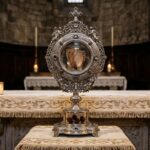





- Time & Location: December 12, 1531, Tepeyac Hill and Bishop Juan de Zumárraga’s residence, Mexico City.
- Physical Phenomenon: An image of the Virgin Mary appeared instantaneously upon coarse cactus-fiber fabric (ayate), displaying luminous colors without surface sizing, underdrawings, or protective varnish.
- Forensic & Optical Verification: NASA biophysical infrared analysis verified the total absence of brushstrokes or recognized 16th-century pigments; corneal ophthalmology under 2,500x digital magnification revealed the Purkinje-Sanson optical reflection of thirteen eyewitnesses inside the microscopic pupils.
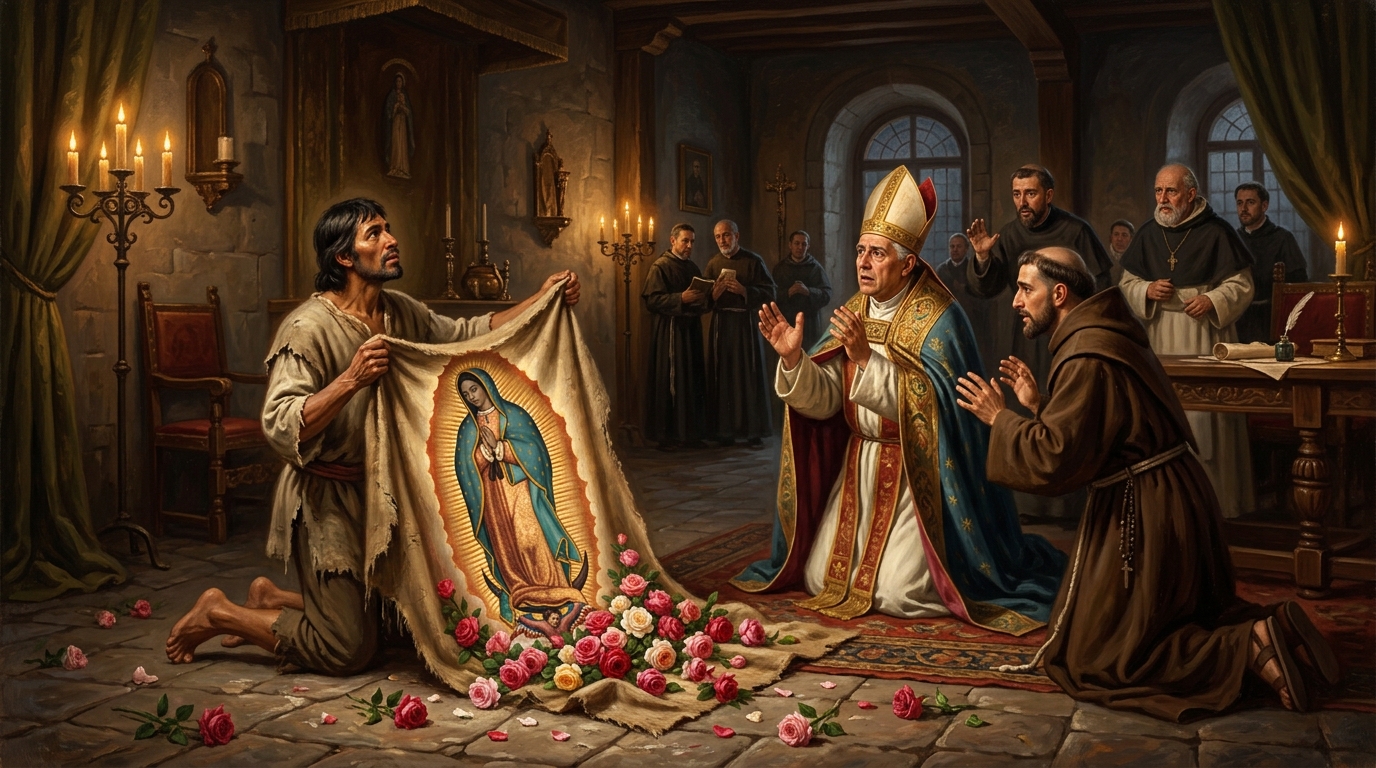
On the cold morning of December 12, 1531, an indigenous Chichimeca peasant named Juan Diego Cuauhtlatoatzin stood in the audience chamber of Fray Juan de Zumárraga, the first Bishop of Mexico. Clutched against his chest was his coarse tilma, an outer cloak hand-woven from rough agave popotule fibers. When the peasant untied the knot at his neck and opened the fabric, dozens of fresh Castilian roses, blooming impossibly in the dead of winter upon frostbitten volcanic soil, cascaded onto the floor.
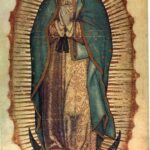
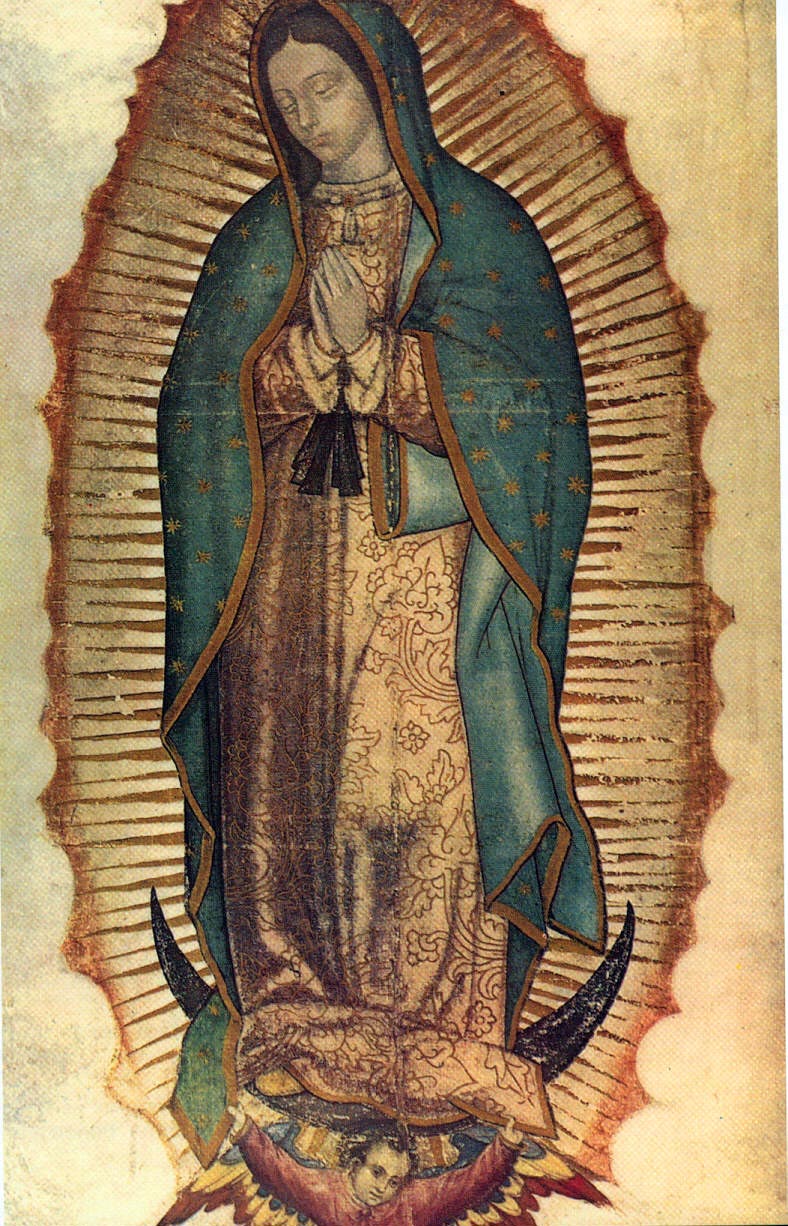
As the bishop and his advisors fell to their knees in reverence, they were not looking at the winter flowers. Stamped upon the rough cactus weave was a life-sized, radiant portrait of a young woman with olive skin, hands joined in prayer, clothed in a rose tunic and a star-strewn mantle of turquoise blue. Her features carried the facial characteristics of both Spanish and indigenous heritage, uniting two warring civilizations in a single portrait.
In the five centuries since that morning, the tilma of Guadalupe has survived harsh environmental conditions that ordinarily reduce organic agave fibers to dust within thirty years. It survived an accidental 1785 nitric acid spill that should have dissolved the cloth, and emerged completely unscathed from a 1921 military bomb blast that twisted a heavy bronze crucifix. For modern investigators, however, the mystery only deepened when 20th-century optics and NASA infrared spectroscopy transformed this sacred textile into one of the most scrutinized forensic artifacts on earth.
The 500-Year Agave Enigma: A Biological Impossibility
From a botanical and material standpoint, the physical survival of the tilma represents an unresolved anomaly. Ayate cloth woven from agave cactus fibers is notoriously perishable. Under the damp, saline air of Mexico City, ancient ayate cloaks degrade, fray, and decompose within twenty to thirty years. For the first 116 years following 1531, the tilma hung completely unprotected in a humid chapel, exposed to candle soot, incense smoke, ambient moisture, and the direct touch of hundreds of thousands of pilgrims.
In 1789, researchers constructed two exact replicas of the image painted on the same agave fiber. Both copies were placed in the same basilica environment; within eight years, both test cloths rotted and faded into illegibility. Yet the original 1531 relic retains its structural elasticity, brilliant coloration, and tactile softness across nearly five centuries.
NASA Infrared Biophysics: An Image Without Brushstrokes
In May 1979, Dr. Philip Serna Callahan, a research biophysicist at the University of Florida and consultant for NASA, accompanied by professor Dr. Jody Brant Smith, conducted an extensive non-destructive study of the tilma using ultraviolet and infrared photography. Their team took over one hundred high-resolution photographs under varying wavelengths to analyze the pigment composition and the underlying surface.
Dr. Callahan’s formal clinical report, later published by the Center for Applied Research in the Apostolate, yielded remarkable conclusions:
- Total Absence of Surface Sizing: In traditional painting, rough cloth must be treated with gesso or animal sizing to seal the pores and create a workable canvas. The Guadalupe tilma has zero preparatory sizing. The paint pigments rest directly on raw cactus fibers without capillary bleeding.
- Zero Identifiable Brushstrokes: Under intense magnification and infrared penetration, the original image exhibits no brushmarks, underdrawings, or preliminary sketches. The coloration appears to hover above the threads, resembling a photographic transfer rather than manual application.
- Unidentifiable Pigment Origin: Dr. Callahan noted that the color pigments do not originate from animal, mineral, or vegetable sources known in sixteenth-century botany or chemistry. German Nobel laureate in chemistry Richard Kuhn previously examined fiber samples in 1936 and similarly concluded that the dyes were neither natural nor synthetic organic compounds.
- Natural Fiber Integration: The figure utilizes natural defects, knots, and variations in the rough weave to create depth across the facial contours, an effect impossible to plan on untreated agave weave.
The Corneal Ophthalmology Discovery: Eyewitnesses in the Pupil
Perhaps the most extraordinary scientific revelation emerged when modern digital image processing was applied to the eyes of the portrait. In 1929 and 1951, ophthalmologists inspecting the image with ophthalmoscopes noticed faint reflections inside the right iris, resembling the optical properties of living human eyes.
Beginning in 1979, Dr. José Aste Tonsmann, an engineering graduate from Cornell University and digital systems specialist at IBM, digitized high-resolution microphotographs of the tilma’s eyes. Magnifying the corneas up to 2,500 times their actual size through advanced digital filtering, Tonsmann investigated whether the image satisfied the Purkinje-Sanson law of optics.
The Purkinje-Sanson effect dictates that a living human eye reflects three distinct images of the objects placed before it: one on the outer surface of the cornea, a second on the inner surface of the cornea, and a third, inverted image on the anterior surface of the lens. To the astonishment of optical physicists, Tonsmann discovered that the microscopic pupils of the Guadalupe image, measuring less than eight millimeters in diameter, preserve these exact optical distortions.
Inside the microscopic corneal reflections of both eyes, Tonsmann identified the complete scene of December 12, 1531: thirteen distinct historical figures, including Juan Diego opening his cloak, Bishop Zumárraga staring in disbelief, a seated indigenous family, and an African woman servant who was documented in contemporaneous household records. The figures reflect the exact perspective an onlooker would have observed from the viewpoint of the image at the instant the tilma was unveiled.
Parallels with Modern Eucharistic and Incorruptible Relics
The scientific anomalies of Guadalupe do not exist in isolation within Christian history. They mirror the medical findings observed at The Eucharistic Miracle of Lanciano, where living left ventricular heart tissue resisted decay for 1,200 years, and the clinical findings at The Buenos Aires Eucharistic Miracle. Furthermore, the total absence of putrefaction matches the medical exhumations of Saint Bernadette Soubirous at Nevers, whose body resisted decay in a water-saturated crypt.
As documented in the digital archive built by Blessed Carlo Acutis, such physical manifestations provide contemporary believers with verifiable anchors, reminding humanity that the spiritual realm operates in harmony with tangible reality.
Spiritual Reality and Practical Discernment
Beyond the laboratory data, the true impact of Our Lady of Guadalupe lies in its historical fruit. In 1531, Central America was gripped by grief and division following the Spanish conquest, while Aztec society was dominated by systemic human sacrifice rituals that claimed thousands of lives each month. Within eight years of the apparition on Tepeyac Hill, an estimated nine million indigenous people voluntarily embraced the Christian faith, an event recognized by historians as the largest spontaneous religious conversion in human history.
The image spoke a visual language the Aztecs understood: the turquoise mantle denoted imperial royalty, the black sash around her waist indicated pregnancy, and the cross brooch at her neck affirmed the Gospel brought by the missionaries. It affirmed human dignity and ended human sacrifice without a single sword drawn.
For modern readers navigating a world often fractured by cynicism, the message of Guadalupe remains timeless: “Am I not here, I who am your mother? Are you not under my shadow and protection? Do not grieve or be troubled by anything.”
Historical Citations & References
- Callahan, P. S. (1981). The Tilma Under Infra-Red Radiation: An Analytical and Physical Study of the Image of Our Lady of Guadalupe. CARA Studies in Popular Devotion, Monograph No. 3. Washington, D.C.
- Tonsmann, J. A. (2001). El Secreto de sus Ojos: Estudio Científico de los Ojos de la Virgen de Guadalupe. Editorial Ruz, Mexico City.
- Smith, J. B. (1983). The Image of Guadalupe: Myth or Miracle? Doubleday & Company.
- Chávez, E. (2006). Our Lady of Guadalupe and Saint Juan Diego: The Historical Evidence. Rowman & Littlefield.
- Congregation for the Causes of Saints. (2002). Positio Super Canonizatione Servi Dei Ioannis Didaci Cuauhtlatoatzin. Typis Vaticanis, Vatican City.