
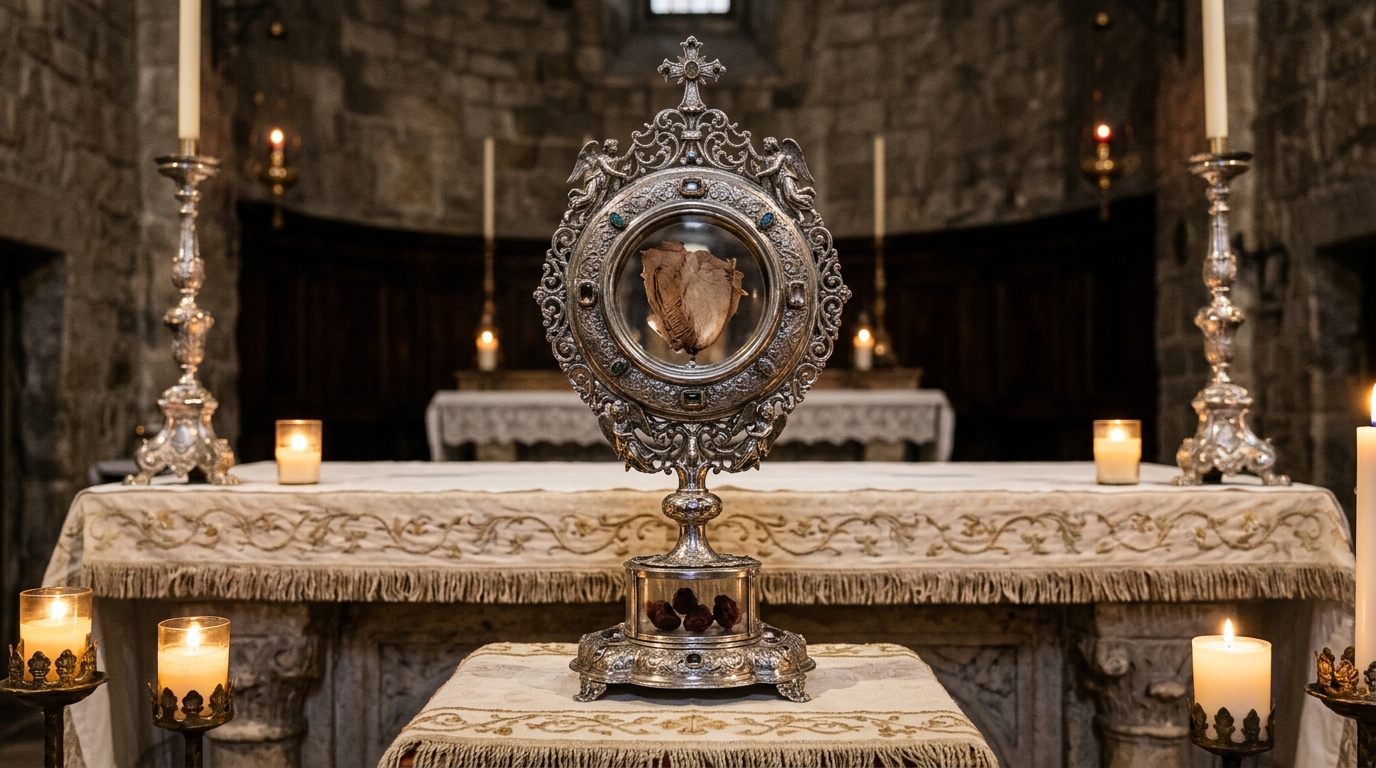

In the eighth century, inside the quiet sanctuary of the Church of St. Longinus in Lanciano, Italy, a Basilian hieromonk celebrated the Holy Sacrifice of the Mass while silently tormented by doubt. Although he was an ordained priest, he wrestled profoundly with the doctrine of Transubstantiation, questioning whether the ordinary bread and wine offered on the altar could truly become the real Body and Blood of Jesus Christ.
The Sudden Transformation at the Words of Consecration
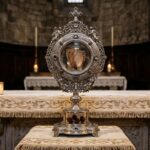
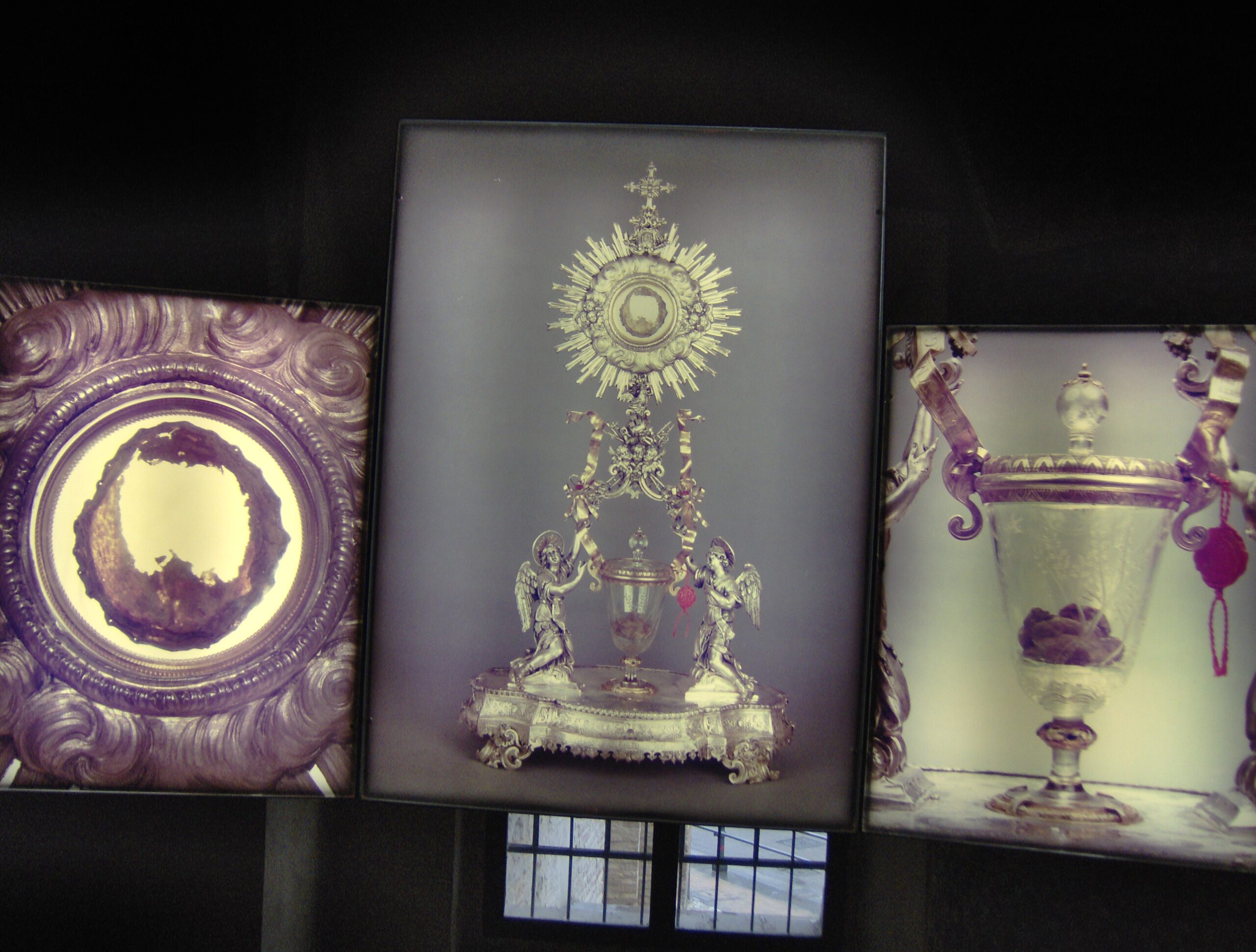
As the monk pronounced the solemn words of consecration over the host and chalice, an extraordinary event occurred before his eyes. The white host visibly transformed into a circular slice of living flesh, while the sacramental wine coagulated into five distinct, reddish globules of blood. Shaken to his core, the priest broke down in tears, confessed his secret doubts to the gathered congregation, and invited the faithful to witness the miraculous physical reality resting on the altar.
The miracle was immediately preserved by the local Christian community. For over twelve centuries, the relics remained sheltered in Lanciano without artificial chemical preservatives, mummification techniques, or hermetic sealing. They survived wars, earthquakes, monastic transfers, and the passage of generations under the guardianship of the Conventual Franciscan Friars at the Sanctuary of the Eucharistic Miracle.
The Landmark 1970–1971 Scientific Investigation
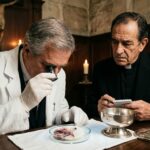
In November 1970, with formal ecclesiastical permission from Archbishop Pacifico Perantoni of Lanciano and the Holy See, the Franciscan friars commissioned a rigorous scientific examination. The investigation was entrusted to Dr. Odoardo Linoli, Professor of Anatomy, Pathological Histology, Chemistry, and Clinical Microscopy, and former Head of the Laboratory of Pathological Anatomy at the Hospital of Arezzo. Dr. Linoli was assisted by Dr. Ruggero Bertelli, Professor Emeritus of Human Anatomy at the University of Siena.
Dr. Linoli extracted microscopic samples from the flesh and blood under strict antiseptic conditions on November 18, 1970, and conducted a thorough histologic and immunochemical analysis. On March 4, 1971, he published his definitive clinical findings:
- Living Myocardial Tissue: The flesh relic is genuine human striated muscular tissue from the heart myocardium, specifically the left ventricle wall. It contains endocardium, myocardial fibers, and nerves.
- Genuine Human Blood: The blood relic consists of real human blood containing normal physiological ratios of proteins, serum albumin, and globulins identical to fresh human blood.
- Identical Blood Group AB: Both the myocardial tissue and the coagulated blood tested positive for human blood group AB, which is universally recognized as the universal recipient type. Remarkably, this is the exact same rare blood type discovered on the Shroud of Turin and subsequent Eucharistic phenomena.
- Total Absence of Embalming Preservatives: Histological examination revealed zero traces of salt, mummy resins, embalming agents, or chemical preservatives. Under normal biological conditions, exposed organic tissue decays within weeks, yet this tissue retained its cellular structure across twelve centuries.
Dr. Linoli’s peer-reviewed paper was later published in Italian medical journals, including Quaderni Sclavo di Diagnostica Clinica e di Laboratori (1971). Subsequent re-evaluations conducted in 1981 confirmed the integrity of Dr. Linoli’s initial conclusions.
Parallel Findings: The Buenos Aires Connection
The scientific conclusions drawn at Lanciano do not stand in isolation. Centuries later, forensic pathologists examining the Buenos Aires Eucharistic Miracle under blind laboratory conditions reached identical conclusions. Dr. Frederic Zugibe, Chief Medical Examiner of Rockland County, New York, analyzed the Argentine sample without knowing its religious origin and concluded it was inflamed human heart myocardium under severe trauma, bearing the same blood type AB.
This enduring connection between ancient and modern Eucharistic phenomena was famously cataloged by Blessed Carlo Acutis, the digital apostle of the Eucharist who documented over 130 Church-approved miracles to help modern skeptics reconcile faith and scientific inquiry.


Theological and Spiritual Significance
For Christians worldwide, the Miracle of Lanciano serves as a profound tangible sign of Christ’s real presence. It began not as a reward for heroic faith, but as a merciful response to a struggling priest’s silent prayer of doubt. In an age dominated by empirical skepticism, Lanciano stands as an intersection where clinical pathology and supernatural reality meet, reminding believers that the mystery celebrated on the altar carries eternal life.
Watch: Investigative Report on the Lanciano Relics
Documentary examination of the 1,300-year-old reliquary preserved in Lanciano, Abruzzo, Italy.
Historical Citations & References
- Linoli, O. (1971). Ricerche istologiche, immunologiche e biochimiche sulla carne e sul sangue del miracolo eucaristico di Lanciano (VIII secolo). Quaderni Sclavo di Diagnostica Clinica e di Laboratori, 7(3), 661–674.
- Santuario del Miracolo Eucaristico di Lanciano. Official Historical and Medical Archives. miracoloeucaristico.eu
- Magis Center for Faith and Science. (2020). The Science of Eucharistic Miracles: Lanciano, Sokolka, and Buenos Aires. magiscenter.com
- Congregation for the Doctrine of the Faith (Vatican). Norms Regarding the Discernment of Alleged Supernatural Phenomena. vatican.va