
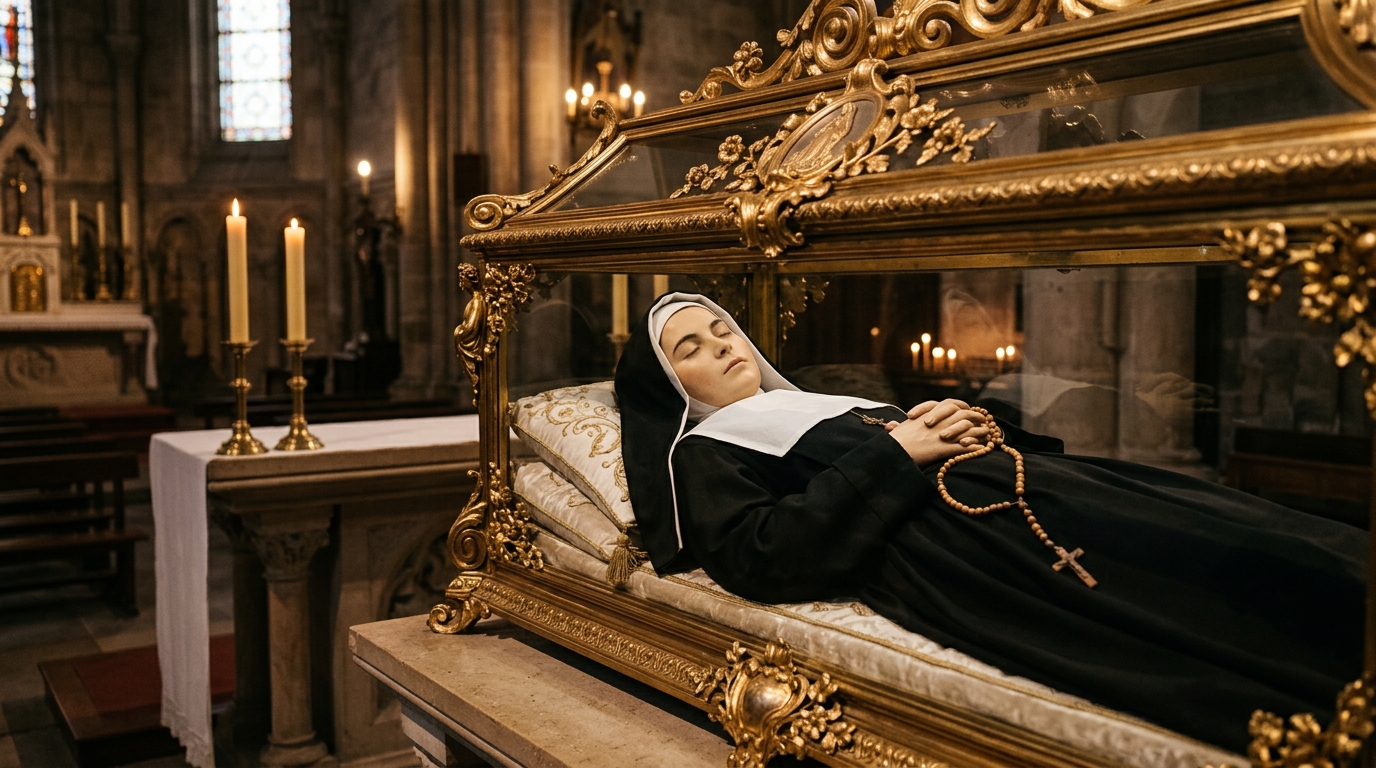

On April 16, 1879, in the infirmary of the Sisters of Charity and Christian Instruction in Nevers, France, thirty-five-year-old Bernadette Soubirous whispered her final words: “Holy Mary, Mother of God, pray for me, a poor sinner.” Clasping her crucifix, the humble visionary who witnessed eighteen apparitions of the Blessed Virgin Mary at the Grotto of Massabielle in Lourdes departed this life after years of enduring debilitating asthma and tuberculosis of the bone.
Her body was buried in the convent garden chapel of Saint Joseph in Nevers, in a damp subterranean vault where corpses ordinarily decompose within months. However, thirty years later, as part of the official Vatican canonical inquiry for her cause of beatification, her tomb was opened. What medical examiners and civil authorities discovered inside the humid oak and lead casket defied every law of biological science.
The Three Official Medical Exhumations (1909, 1919, and 1925)
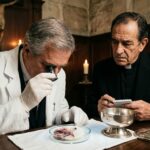
Under the supervision of the Bishop of Nevers, the Prefect of the Department of Nievre, and civil witnesses, independent physicians conducted three separate official medical examinations over a span of sixteen years:
- First Exhumation (September 22, 1909): Doctors Ch. David and A. Jordan opened the casket. In their official notarized medical report, Dr. Jordan recorded: “The coffin was opened in the presence of the Bishop of Nevers… I noticed no smell. The body was clothed in the habit of the Congregation. The habit was damp. The face was dull white, the skin clinging to the muscle and the muscles adhering to the bones… The teeth were white and the nails of the hands were completely intact.” While the rosary in her hands was heavily oxidized and the crucifix had turned green from the damp soil, her flesh showed zero mummification or putrefaction.
- Second Exhumation (April 3, 1919): Ten years later, Doctors Talon and Comte re-examined the body. Their findings confirmed that the skin, nails, teeth, eyelashes, and internal soft tissues remained remarkably intact, with flexible muscles and total absence of odor.
- Third Exhumation (April 18, 1925): Prior to Bernadette’s beatification by Pope Pius XI, Dr. Comte conducted an extensive anatomical inspection. When he surgically extracted two ribs as sacred relics, he noted that the internal liver tissue was soft, hydrated, and exhibited normal anatomical consistency rather than calcified or rotted tissue. Dr. Comte wrote in his report: “What struck me during this examination, of course, was the state of perfect preservation of the skeleton, the fibrous tissues of the muscles, the flexible ligaments, and the skin… It is a phenomenon that is outside the realm of natural physical laws.”
Lourdes Miracles and the Connection to Healing Waters
The miraculous preservation of Saint Bernadette echoes the miraculous healing stream that first gushed forth when she obediently dug into the mud of the Massabielle Grotto in 1858. Over the decades, thousands of medically documented recoveries have occurred through the intercession of Our Lady of Lourdes, starting with early recognized miracles like The Miraculous Healing of Catherine Latapie, whose paralyzed hand was restored overnight in the icy spring.
To this day, the International Medical Committee of Lourdes (CMIL), an independent consortium of world-class physicians, maintains rigorous clinical standards to verify unexplainable healings, detailed in our study on The Miracles of Lourdes: A Testament to Faith and Healing.
Veneration at the Chapel of Saint-Gildard
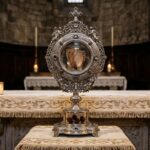
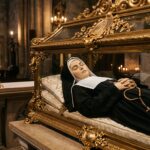
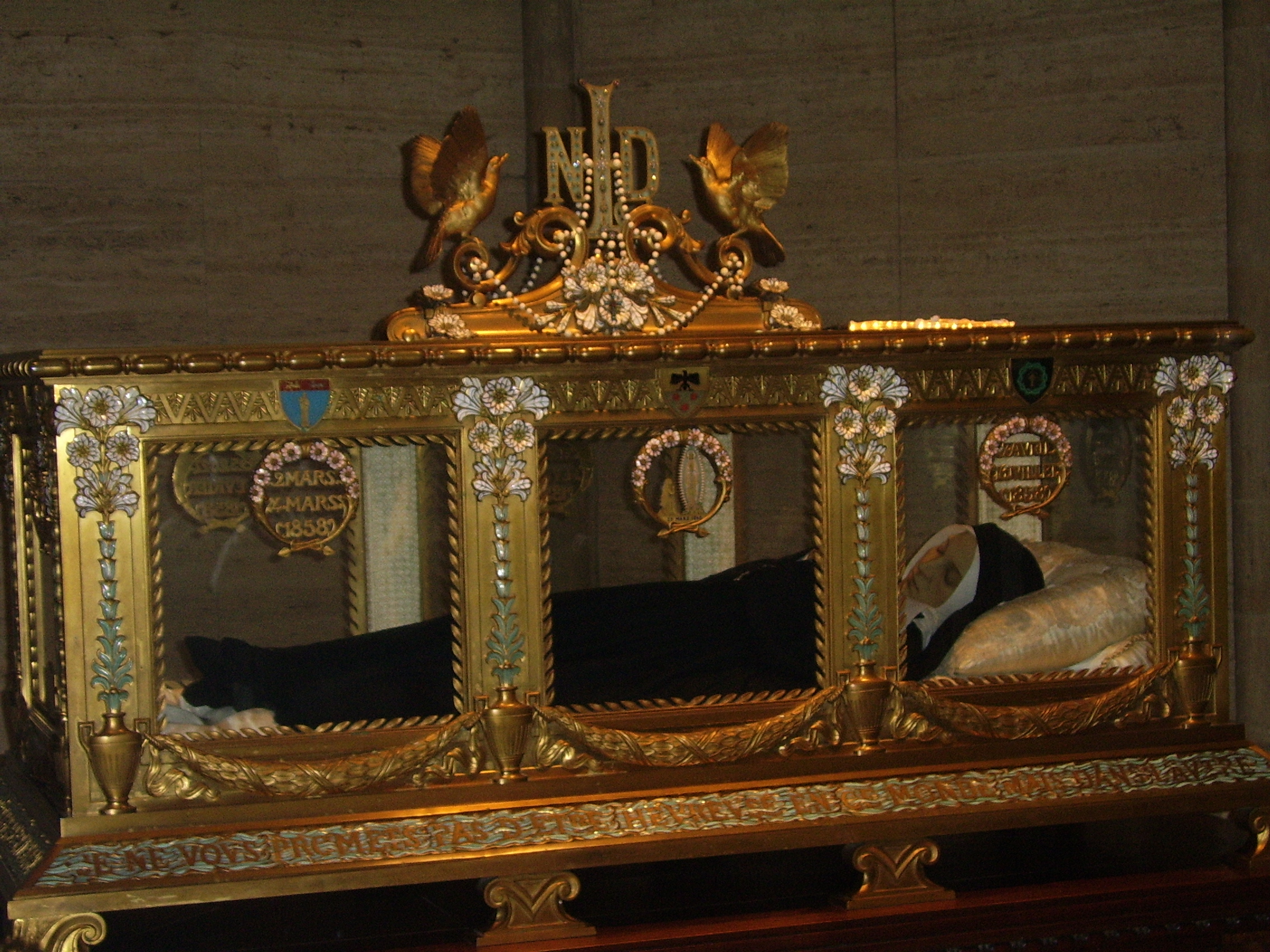
Following her canonization by Pope Pius XI on the Feast of the Immaculate Conception in 1933, Saint Bernadette’s body was placed in an ornate reliquary of gilded bronze and crystal in the Chapel of Saint-Gildard in Nevers. A very light, transparent wax mask was designed by the firm Pierre Imans of Paris to cover her face and hands, guarding against discoloration caused by exposure to atmospheric light.
Bernadette once said of her life: “The Virgin Mary used me as a broom to dust the corners. When the work is done, the broom is put behind the door again.” Yet in God’s providence, the little shepherd girl who never sought earthly acclaim rests before millions of pilgrims as an incorruptible sign of the resurrection of the body promised in Christian theology.
Watch: The Medical Exhumations of Saint Bernadette
Historical examination of the medical exhumations of 1909, 1919, and 1925 conducted in Nevers, France.
Historical Citations & References
- Comte, H. (1928). Rapport médical officiel sur la troisième exhumation du corps de Sainte Bernadette Soubirous. Archives Diocésaines de Nevers et de Lourdes.
- Laurentin, R. (1979). Bernadette of Lourdes: A Life Based on Authenticated Documents. Winston Press.
- Trochu, F. (1957). Saint Bernadette Soubirous: 1844–1879. Tan Books and Publishers.
- Sanctuary of Our Lady of Lourdes (Bureau des Constatations Médicales). Official Archives of Canonical Exhumations. lourdes-france.org