

How an uneducated Polish peasant nun documented 1,828 interior revelations, sparked the 20th century’s most influential sacred artwork, and saw her writings survive a twenty-year Holy Office prohibition.
Key Findings & Archival Record
- Subject & Dates: Helena Kowalska (religious name: Sister Maria Faustina of the Blessed Sacrament), born August 25, 1905, in Głogowiec, Congress Poland; died October 5, 1938, in Kraków-Łagiewniki at age 33.
- Primary Document: A handwritten spiritual journal comprising six notebooks and a supplementary essay on Holy Communion, published as Divine Mercy in My Soul (1,828 numbered entries, approximately 215,000 words).
- Physical & Mystical Phenomena: Bilocation, invisible stigmata, prophetic visions of World War II and the destruction of Warsaw, encounters with demonic manifestations, and direct dictations regarding five distinct devotional forms.
- Ecclesiastical & Forensic History: The original Vilnius image painted by Eugeniusz Kazimirowski (1934) under Faustina’s weeping supervision; subjected to a twenty-year Holy Office notification ban (1959–1978) caused by flawed Italian translations, subsequently vindicated through an academic investigation initiated by Cardinal Karol Wojtyła (Pope John Paul II) and canonized on April 30, 2000.
1. Scene Lede: The Weeping Mystic and the Vilnius Studio
In June 1934, inside a sunlit second-floor studio on Rasų Street in Vilnius, an academic painter named Eugeniusz Kazimirowski cleaned his oil brushes, stepped back from an easel, and waited for a verdict.
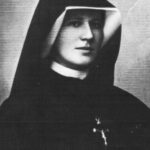
Beside him stood Father Michał Sopoćko, a professor of pastoral theology at Stefan Batory University who had spent months posing in a white priest’s alb so the artist could capture the precise drape of Christ’s tunic. Sitting quietly in the corner was Sister Maria Faustina Kowalska, a twenty-eight-year-old sister of the second choir from the Congregation of the Sisters of Our Lady of Mercy.
Kazimirowski was a consummate professional, trained in the fine arts academies of Kraków, Munich, and Paris. His task had been deceptively simple yet spiritually impossible: transfer to canvas an apparition that Faustina had witnessed three years earlier inside her freezing convent cell in Płock.
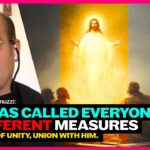
Faustina studied the finished canvas. She inspected the raised right hand of blessing, the lowered eyes casting a tender gaze downward, and the two broad beams of light streaming from the chest, one pale as water, the other deep crimson.
Then, to the painter’s bewilderment, the young nun covered her face with her hands and burst into bitter weeping.
She did not thank Kazimirowski. She rushed straight to the chapel of the Bernardine Sisters nearby, knelt before the tabernacle, and cried out into the empty sanctuary: “Who will paint You as beautiful as You are?”
Faustina’s immediate tears reveal the core tension running through the life of modern Christianity’s greatest mystic. She was an uneducated domestic servant who had received less than three years of rudimentary schooling, yet she was commanded by Heaven to transmit a message of eschatological urgency to an increasingly secular, violent world.

She did not seek visibility, nor did she find comfort in human talent. In response to her grief in the chapel, she heard an interior voice reply with clinical finality:
“Not in the beauty of the color, nor of the brush lies the greatness of this image, but in My grace.” (Diary, 313)
For modern seekers navigating a culture paralyzed by performance anxiety, personal inadequacy, and institutional cynicism, Faustina Kowalska’s life offers a radical counterweight. Her mission proves that when Divine Providence decides to communicate with humanity, it bypasses human intellectual credentials to anchor its power in broken, humble vessels.
2. Archival Record: From Peasant Housekeeper to Cloistered Scribe
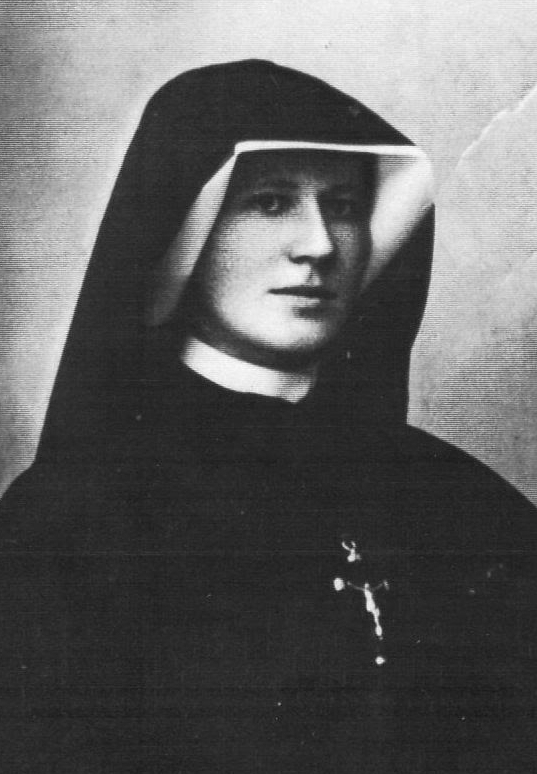
Helena Kowalska was born on August 25, 1905, in the dusty village of Głogowiec, the third of ten children born to Stanisław Kowalski and Marianna Nowicka. The family lived in poverty, sharing a two-room house made of local limestone.
Helena’s schooling ended after just three winter terms because older siblings needed shoes and clothes to attend. At fourteen, she left home to work as a domestic servant for wealthy families in Aleksandrów and Łódź, sending her wages home to support her parents.
Her spiritual life was characterized from early childhood by an unusual gravity. At age seven, she experienced her first interior calling during an exposition of the Blessed Sacrament.
Yet her path into religious life was repeatedly blocked. When she begged her parents for permission to enter a convent, her father adamantly refused, citing their crushing debts and lack of money for a religious dowry.
The turning point occurred in the summer of 1924 at a public dance park in Łódź:
“While everybody was having a good time, my soul was experiencing deep torments. As I began to dance, I suddenly saw Jesus at my side, Jesus racked with pain, stripped of His clothing, all covered with wounds, who spoke these words to me: How long shall I put up with you and how long will you keep putting Me off?” (Diary, 9)
Leaving the ballroom in shock, she took refuge in the Cathedral of Saint Stanislaus Kostka, wept before the altar, and received an interior instruction to leave for Warsaw immediately. With only the dress she wore, she boarded the train.
Convent after convent rejected the penniless, uneducated girl. Finally, Mother Michaela Moraczewska of the Congregation of the Sisters of Our Lady of Mercy agreed to accept her, on the condition that Helena work as a housemaid for a year to earn money for her modest habit.
On April 30, 1926, she received the habit and the name Sister Maria Faustina. Because she lacked education, she was placed in the “second choir” of the congregation, a tier dedicated to manual labor: cooking, cleaning, gardening, and answering the convent gate. Her life appeared outwardly routine, unremarkable, and monotonous to the outside world.
3. The Forensic Verification: Płock, Vilnius, and the 1934 Canvas
The mystical explosions began in earnest on the evening of February 22, 1931, in the convent of Płock:
“In the evening, when I was in my cell, I saw the Lord Jesus clothed in a white garment. One hand [was] raised in the gesture of blessing, the other was touching the garment at the breast. From beneath the garment, slightly drawn aside at the breast, there were emanating two large rays, one red, the other pale. In silence I kept my gaze fixed upon the Lord; my soul was struck with awe, but also with great joy. After a while, Jesus said to me, Paint an image according to the pattern you see, with the signature: Jesus, I trust in You.” (Diary, 47)
Faustina’s immediate superior, Mother Rose Kłobukowska, greeted the report with skepticism, handing Faustina a paintbrush and demanding that she prove the apparition herself. Confessors dismissed her visions as hysteria, hallucinations, or spiritual pride.
The stalemate ended only when Faustina was transferred to Vilnius in May 1933. There, she met her newly appointed confessor, Father Michał Sopoćko.
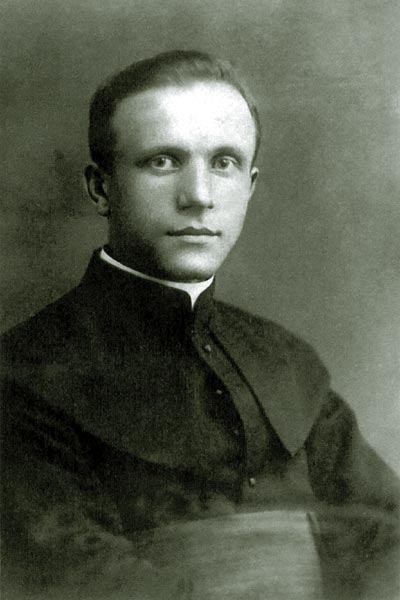
Sopoćko did not accept Faustina’s claims on blind faith. As a trained academic theologian, he subjected her to rigorous psychiatric evaluation by Dr. Helena Maciejewska, a leading psychiatrist in Vilnius. Dr. Maciejewska certified that Faustina was completely sane, mentally balanced, and free from any neurotic or delusional tendencies.
Satisfied that his penitent was balanced, Sopoćko personally funded the painting project, renting a studio space and commissioning Eugeniusz Kazimirowski. Over the course of six months, from January to June 1934, Faustina visited the studio at least once a week, correcting the position of the hands, the tilt of the head, and the intensity of the light.
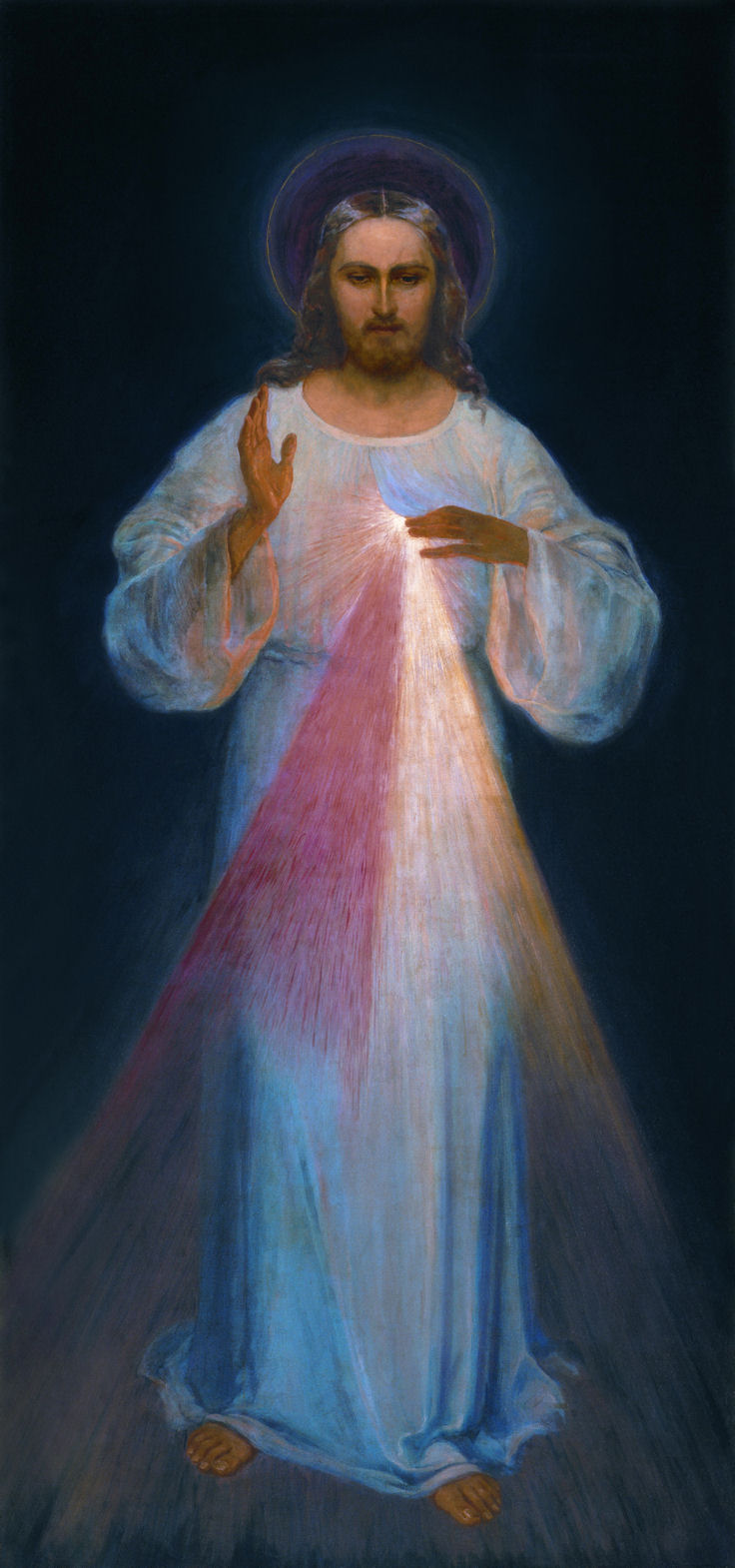
When Sopoćko asked Faustina to question Christ on the precise meaning of the two rays, Faustina returned with the theological definition that remains central to Catholic doctrine:
“The two rays denote Blood and Water. The pale ray stands for the Water which makes souls righteous. The red ray stands for the Blood which is the life of souls. These two rays issued forth from the very depths of My tender mercy when My agonized Heart was opened by a lance on the Cross.” (Diary, 299)
Modern Scientific Corroboration: The Shroud of Turin Alignment
Decades after Faustina’s death, independent forensic researchers and art historians subjected Kazimirowski’s original 1934 Vilnius canvas to high-resolution photographic scanning. When digital overlays were made comparing the face of Christ on the Vilnius painting with the face of the Man on the Shroud of Turin, researchers discovered a 1:1 biometric correspondence.
The distance between the pupils, the width of the nasal bridge, the curvature of the jawline, and facial proportions align with statistical precision, despite Kazimirowski having never seen the Shroud of Turin, which was stored in Italy and had only recently been photographed for the first time by Secondo Pia in 1898.
4. The Five Vessels of Mercy: A New Spiritual Arsenal
Between 1931 and her death in 1938, Faustina recorded five distinct, practical devotional structures dictated to her during prayer. These are not sentimental meditations; they represent an integrated spiritual system aimed at the conversion of sinners and preparation for Christ’s return:
- The Image of Divine Mercy (Diary, 47–48): Inscribed with the signature “Jesus, I trust in You”. Christ attached the promise of divine defense at the hour of death and victory over spiritual enemies.
- The Feast of Mercy (Diary, 49, 699): Demanded on the First Sunday after Easter. Carries the extraordinary promise of total remission of all sins and temporal punishment for those who receive Holy Communion in a state of grace.
- The Chaplet of Divine Mercy (Diary, 474–476): Dictated in Vilnius on September 13–14, 1935, following a vision of an Angel of Wrath sent to strike an earthly city. Recited on ordinary rosary beads, offering Christ’s Body and Blood to the Eternal Father. This intimate Eucharistic reality mirrors the forensic mysteries documented in the Eucharistic Miracle of Lanciano and the living myocardium identified in the Buenos Aires Eucharistic investigation.
- The Hour of Great Mercy (Diary, 1320, 1572): Observed daily at 3:00 PM, the hour of the Crucifixion. Christ promised: “In this hour, I will refuse nothing to the soul that makes a request of Me in virtue of My Passion.”
- Spreading the Devotion (Diary, 1075, 1142): Practicing mercy through deeds, words, and prayers. Christ pledged to shield souls who spread His mercy throughout their entire lives and comfort them at death.
5. The Crucible of Sickness and Hidden Spiritual Warfare
While Faustina was recording these revelations, her physical body was disintegrating. By late 1935, she had contracted pulmonary and intestinal tuberculosis. In the 1930s, tuberculosis was incurable, highly contagious, and carried severe social stigma.
Because Faustina made every effort to hide her intense physical suffering to spare the convent extra labor, several older sisters accused her of malingering, laziness, and seeking special diet privileges.
She was eventually sent to the Prądnik Sanatorium outside Kraków. There, she was confined to an isolation ward, coughing up blood, enduring severe fevers, and writing her diary during moments of remission. Yet she documented an even darker interior struggle: the experience of profound spiritual desolation, described by mystics as the “Dark Night of the Soul”:
“My mind became clouded in a strange way; all religious truths seemed to me obscure and unintelligible… I felt that God had rejected me completely… I could not pray, neither could I meditate. When I tried to force myself to pray, my thoughts were scattered like sand in a desert.” (Diary, 77)
Throughout these interior agonies, she recorded direct psychological and spiritual attacks by demonic entities. On multiple occasions, invisible forces threw her furniture, battered her body, and whispered accusations into her mind: that her diary was a fraud, that she had deceived her confessors, and that she was irrevocably damned (Diary, 713, 1460).
Her sole weapons were radical obedience to her confessor, the Sign of the Cross, and clinging to the phrase: “Jesus, I trust in You.”
By late September 1938, her lungs were almost entirely consumed. On October 5, 1938, at 10:45 in the evening, Sister Faustina turned to the sister nursing her and whispered her final words. At the age of thirty-three, having lived in total religious obscurity, she died peacefully in her convent bed.
6. The Twenty-Year Vatican Ban: The Trial of Divine Mercy
The story of St. Faustina does not end with her death; it enters a phase of bureaucratic and ecclesiastical testing.
During World War II, as Poland lay crushed beneath the dual occupations of Nazi Germany and Soviet Russia, the Devotion to Divine Mercy spread like wildfire. Millions of Polish soldiers and civilians carried copies of the Chaplet and small prints of the Image into concentration camps and battlefields as their primary anchor of hope.
However, rapid underground proliferation created severe problems. Flawed translations of Faustina’s Diary into Italian and French circulated throughout Europe. These translations contained serious theological distortions: some phrases suggested that Faustina was claiming God’s mercy superseded His justice entirely, bordering on theological quietism and heresy.
On March 6, 1959, the Supreme Sacred Congregation of the Holy Office (now the Dicastery for the Doctrine of the Faith) issued a formal Notification: the public display of images according to Sister Faustina’s pattern was banned, and Father Michał Sopoćko received a severe official reprimand from Rome.
For nearly twenty years, the message of Divine Mercy was officially silenced within the Catholic Church.
The Critical Vindication by Cardinal Karol Wojtyła
The ban would have remained permanent were it not for the young Archbishop of Kraków, Cardinal Karol Wojtyła. In 1965, with permission from the Holy Office, he initiated an official Informative Process into the life and virtues of Sister Faustina.
He commissioned Professor Ignacy Różycki, a leading dogmatic theologian who was initially skeptical of Faustina, to conduct a comprehensive critical analysis of the original handwritten Polish manuscripts.
Różycki spent years cross-referencing every single word. His final report proved conclusively that the Vatican’s previous concerns were entirely the result of amateurish, inaccurate Italian translations. Faustina’s original theology was completely orthodox, deeply rooted in the Church Fathers and Saint Thomas Aquinas.
On April 15, 1978, the Holy Office formally revoked the 1959 ban. Six months later, on October 16, 1978, Cardinal Karol Wojtyła was elected to the Papacy as Pope John Paul II.
On April 30, 2000, in Saint Peter’s Square before hundreds of thousands of pilgrims, Pope John Paul II canonized Sister Maria Faustina Kowalska as the First Saint of the New Millennium, officially establishing the Sunday after Easter as Divine Mercy Sunday across the universal Catholic Church.
7. Spiritual Reality and Discernment: The Eschatological Spark
Why does Faustina Kowalska matter today?
Her writings are not merely comfort literature for private prayer rooms. They carry an explicit eschatological warning. In one of her final notebook entries, Faustina recorded a prophecy concerning the modern era:
“As I was praying for Poland, I heard the words: I bear a special love for Poland, and if she will be obedient to My will, I will exalt her in might and holiness. From her will come forth the spark that will prepare the world for My final coming.” (Diary, 1732)
The central paradox of Divine Mercy is that it is not sentimentality. Jesus explicitly warned Faustina that time is limited:
“Write this: Before I come as the Just Judge, I am coming first as the King of Mercy. Before the day of justice arrives, there will be given to people a sign in the heavens of this sort: All light in the heavens will be extinguished, and there will be great darkness over the whole earth. Then the sign of the cross will be seen in the sky…” (Diary, 83)
Actionable Takeaways for Daily Spiritual Life
- The Law of Daily Recourse: Pray the Chaplet of Divine Mercy, especially during times of acute personal chaos or at the bedside of the sick and dying.
- The 3:00 PM Pause: Take thirty seconds at the Hour of Mercy (the hour of Christ’s death) to detach from work, recall the Cross, and offer a silent plea for someone who has rejected faith.
- The Practical Law of Mercy: Cultivate mercy not as an abstract feeling, but through three daily concrete avenues: deeds of charity, words of forgiveness, and quiet intercessory prayer (Diary, 742).
Institutional Bibliography & Primary Sources
Primary Archival Documentation:
- Kowalska, St. Maria Faustina. Diary of Saint Maria Faustina Kowalska: Divine Mercy in My Soul. Stockbridge, MA: Marian Press, 2005. (Official critical edition translated from the Polish original manuscripts preserved in Kraków-Łagiewniki).
- Sopoćko, Blessed Michał. Memoirs of the Venerable Servant of God Sister Faustina Kowalska. Białystok Archdiocesan Archives, MS 1948.
- Congregation of the Sisters of Our Lady of Mercy. Chronicle of the Houses in Płock, Vilnius, and Kraków-Łagiewniki (1925–1938). Archives of the Generalate, Warsaw.
Ecclesiastical Acts & Critical Studies:
- Różycki, Rev. Ignacy. The Essential Features of the Divine Mercy Devotion: A Theological Evaluation of the Writings of Sister Faustina Kowalska. Rome: Sacred Congregation for the Causes of Saints, 1979.
- Congregation for the Doctrine of the Faith. Acta Apostolicae Sedis: Notification Concerning the Writings and Devotions Associated with Sister Faustina Kowalska, AAS 51 (1959): 271. Revocation: AAS 70 (1978): 350.
- John Paul II, Pope. Encyclical Letter: Dives in Misericordia (Rich in Mercy). Vatican City: Libreria Editrice Vaticana, November 30, 1980.
- John Paul II, Pope. Homily at the Canonization of Saint Maria Faustina Kowalska. Saint Peter’s Square, Vatican City, April 30, 2000.