




Key Findings & Archival Record
- Common Error: Misinterpreting Divine Mercy as Universalism (the un-Biblical theory that everyone is automatically saved regardless of repentance).
- Faustina’s Explicit Teaching: Mercy is offered freely, but it must be freely received through repentance; those who reject mercy face inexorable justice.
- Theological Axiom: Diary entry 1146: “He who refuses to pass through the door of My mercy must pass through the door of My justice.”
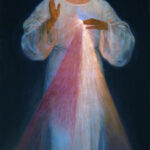
One of the most dangerous distortions of Saint Maria Faustina Kowalska’s revelation in modern pulpits is the reduction of Divine Mercy to sentimental universalism. In contemporary spiritual discourse, mercy is often conflated with moral indifference: a comforting assumption that God does not mind sin, that repentance is unnecessary, and that hell is an empty mythological threat. Yet anyone who reads Faustina’s original Polish notebooks discovers an uncompromising spiritual reality that directly repudiates this laxity.
Faustina’s message is an emergency ultimatum. Divine Mercy is not a celestial participation trophy; it is a lifeboat deployed before an impending shipwreck. In entry 1146, Christ explicitly stated: “Before I come as a just Judge, I first open wide the door of My mercy. He who refuses to pass through the door of My mercy must pass through the door of My justice.”
The nut graph of this theological distinction establishes that mercy without repentance is a dangerous illusion. If God were to forgive unrepentant malice without the consent of the human will, He would violate the very moral freedom He endowed upon mankind, turning love into tyranny.

The Vision of Hell: An Objective Forensic Reality
Those who argue that Faustina preached universal salvation must confront Diary entry 741, wherein she documented an eight-day mystical descent into hell in October 1936. Her description was clinical and horrifying: “I, Sister Faustina, by order of God, have visited the abysses of hell so that I might confirm to souls that hell exists… Most of the souls there are those who disbelieved there is a hell.”
Faustina noted that the ultimate torment of the damned was not physical fire, but the absolute loss of God and the unending agony of their own self-chosen hatred. Divine Mercy cannot force itself upon a soul that stubbornly chooses eternal rebellion.
Mercy as the Limit Imposed on Evil
As Pope John Paul II wrote in his seminal work Memory and Identity, the mercy of God is the divine limit imposed upon evil. Justice ensures that righteousness is vindicated and that victims of violence are ultimately avenged; mercy ensures that the perpetrator has every possible chance to turn away from destruction before the judgment seat is reached. Divine Mercy does not abolish justice; it fulfills it by paying the price on the Cross.
Archival Sources & Verification
Kowalska, Maria Faustina. Diary: Divine Mercy in My Soul. Stockbridge, MA: Marian Press, 2005.
John Paul II. Memory and Identity: Conversations at the Dawn of a Millennium. New York: Rizzoli, 2005.
Benedict XVI. Spe Salvi: On Christian Hope. Vatican City, 2007.