



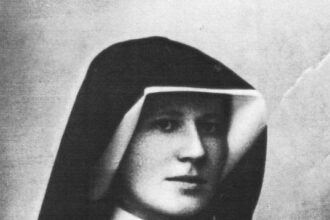
In the winter of 1937, inside the infirmary of the convent at Kraków-Łagiewniki, Sister Maria Faustina Kowalska recorded five extraordinary, word-for-word interior dialogues between Jesus Christ and five different types of human souls: the sinful soul, the despairing soul, the suffering soul, the soul striving for perfection, and the perfect soul. Among these mystical transcripts, none carries such raw psychological urgency and clinical tenderness as Diary entry 1486: the Dialogue with a Despairing Soul. Written for men and women standing on the literal precipice of suicide, existential exhaustion, and unendurable guilt, Christ’s words operate as an emergency lifeline lowered into the deepest abyss of the human psyche.
Key Findings & Archival Record
- Source Text: Dictated to Saint Faustina in Kraków, late 1937; recorded in Diary, paragraph 1486.
- Psychological Target: The human soul trapped in compulsive self-loathing, believing its sins are unforgivable and that annihilation is the only escape.
- Christ’s Verbatim Appeal: “O soul steeped in darkness, do not despair. All is not yet lost. Come and talk with your God, who is Love and Mercy itself.”
- The Turning Point: Christ reminds the soul that its misery is merely a grain of sand dropped into the blazing furnace of His infinite love, proving that despair is not humility, but subtle pride.
1. Scene Lede: The Voice in the Abyss
The winter of 1937 in Kraków was bitterly cold. Confined to her monastic bed with advancing tuberculosis, Sister Faustina spent long nights listening to the spiritual groaning of a world in torment. She saw souls throughout Poland, Europe, and across the globe who were crushed by the weight of secret moral failure, financial bankruptcy, broken marriages, and catastrophic shame. For these individuals, the conventional platitudes of religious culture felt like mockery.
Into this blackness, Christ dictated the dialogue of entry 1486. Unlike theological treatises written in scholastic jargon, this transcript reads like an emergency call between a suicidal patient and a skilled physician who refuses to hang up the phone. The conversation begins with the soul frozen in total isolation:
The Soul: Lord, I hear Your voice calling me, but I dare not come, for I am a wretched sinner… There is no mercy for me. I am damned.”
The nut graph of this dialogue exposes the subtle arrogance hidden beneath despair. Despair masquerades as extreme humility, claiming, “I am too unworthy to be forgiven.” In reality, despair is the ultimate egoism: it claims that my sin is greater than God’s power to save, placing human failure above the infinite value of the Blood shed on Calvary.

2. The Anatomical Breakdown: Dismantling the Trap of Shame
As the dialogue unfolds, Christ dismantles the soul’s self-destructive logic step by step. When the soul insists that its sins are too vile to confess, Jesus responds by claiming ownership of the sinner:
“My child, all your sins have not wounded My Heart as painfully as your present lack of trust does—that after so many efforts of My love and mercy, you should still doubt My goodness.” (Diary, 1486).
Here Christ introduces a stunning theological reality. The murderer, the adulterer, the thief, and the liar grieve God, but their sin remains finite. It is only when the soul refuses to believe in divine mercy that it strikes at the very essence of God. To believe that God cannot or will not forgive is to call God a liar.
Christ then plays His ultimate card: the memory of Calvary. He points to the Two Rays of Blood and Water pouring from His pierced side: “Behold, for you I established a throne of mercy on earth—the tabernacle—and from this throne I desire to enter into your heart. I am not surrounded by a retinue of guards. You have access to Me at any moment, at any time of day.”


3. The Moment of Surrender: The Grain of Sand in the Ocean
The turning point of the dialogue occurs when the soul finally relents, ceasing to defend its guilt and allowing itself to be loved. In entry 1486, the soul whispers: “Lord, I see Your goodness, but my misery is so great…”
Jesus replies with an analogy that has rescued millions from despair: “Were a soul like a decaying corpse so that from a human standpoint there would be no hope of restoration and everything would already be lost, it is not so with God. The miracle of Divine Mercy restores that soul in full. O, how miserable are those who do not take advantage of the miracle of God’s mercy! You will call out in vain, but it will be too late.”
As we saw in our examination of convent spiritual warfare, the devil’s ultimate goal is to isolate the soul in shame. Entry 1486 shatters that isolation by proving that your past is powerless against the infinite ocean of God’s present mercy.

4. Spiritual Reality & Discernment: Practical Lifeline for Today
If you or someone you love is currently trapped in the darkness of despair, depression, or debilitating guilt, print out Diary entry 1486 and read it aloud.
Three Actionable Steps for the Darkness
1. Stop Comparing Your Sins to Human Standards: You are not measuring your faults against your neighbor or your own idealized self-image; you are casting them into an infinite furnace. An infinite furnace consumes a mountain of dry straw in a micro-second.
2. Make an Act of Imperfect Trust: You do not need to feel joyful or peaceful. Trust is not an emotion; it is an act of the will. Simply speak the words into the dark: “Jesus, even though I feel nothing, even though I hate myself, I choose to trust You.”
3. Seek the Sacrament of Reconciliation: As Christ promises on Mercy Sunday, the confessional is not a courtroom where you are condemned; it is a spiritual hospital where the physician binds your wounds.
Institutional Bibliography & Archival Records
Kowalska, Saint Maria Faustina. Diary: Divine Mercy in My Soul. Stockbridge, MA: Marian Press, 2005. Entries 1485–1489.
Torrell, Jean-Pierre. Saint Thomas Aquinas: Spiritual Master. Washington, D.C.: Catholic University of America Press, 2003.
Pobóg-Lenartowicz, Anna. Miłosierdzie Boże Ratunkiem dla Świata: Teologia Dzienniczka. Opole: Wydawnictwo Świętego Krzyża, 2004.
Congregation of the Sisters of Our Lady of Mercy. Archival Dossier on Faustina’s Kraków Infirmary Writings. Kraków, Poland.