
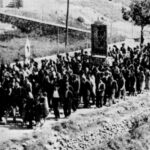

From the morning of September 23 to the evening of September 26, 1968, the town of San Giovanni Rotondo witnessed an unprecedented human deluge. Over one hundred thousand men and women climbed the steep slopes of Mount Gargano on foot, by bus, and in chartered trains to pass before the open casket of Padre Pio. Italian state authorities mobilized military battalions to manage the crowd as the mountain echoed with tears, hymns, and spontaneous prayers.
Key Findings & Archival Record
- Lying-in-State Duration: September 23 to 26, 1968 (nearly 90 continuous hours of public veneration inside the new church of Our Lady of Grace).
- Crowd Estimates: Official Italian Ministry of Interior estimates exceeded 100,000 pilgrims, with lines stretching over three miles into the valley.
- Funeral Liturgy: Celebrated on September 26, 1968, by Father Clemente of Santa Maria in Punta, Minister General of the Capuchin Order, along with scores of bishops and priests.
- Burial: Encased in a multi-layered coffin of chestnut, zinc, and lead, and deposited in the subterranean crypt carved into the limestone rock beneath the sanctuary.
The four days following Padre Pio’s death shattered any lingering suspicion that devotion to the friar was a passing provincial fad. The sheer scale of the mourning paralyzed transportation across Southern Italy and forced civil authorities to declare a state of municipal emergency.
The Scene Lede: A Three-Mile Line in the Gargano Sun
As news of the death flashed across international radio and television networks on Monday morning, the roads leading to Foggia and San Giovanni Rotondo became completely jammed. Pilgrims abandoned cars and buses miles down the mountain and walked uphill on foot through the heat. Farmers, university professors, military officers, and weeping mothers with infants formed a disciplined line four people deep, winding through the village streets and up the convent hill.
Inside the church, Padre Pio’s body lay in state, dressed in his worn Capuchin habit, his bare hands folded over a crucifix. Thousands filed past every hour, touching rosaries, medals, and wedding rings to the glass of the coffin. Italian Carabinieri stood honor guard day and night to keep the procession moving smoothly.

The Nut Graph: A Triumph of Love Over Bureaucracy
For fifty years, ecclesiastical bureaucrats and hostile skeptics had attempted to restrict, silence, and isolate Padre Pio. Yet at his death, no decree from Rome or secular critique could prevent the spontaneous outpouring of global love. The very people he had served in the confessional: the broken, the forgiven, the healed, and the converted: arrived to claim their father.
The scene proved that authentic spiritual authority is not manufactured by administrative titles or public relations campaigns. It is born of sacrifice, prayer, and blood. Padre Pio had poured out his life for half a century, and the world recognized in his passing the departure of a genuine apostle of Christ.
Forensic Evidence & Archival Records: The Solemn Entombment
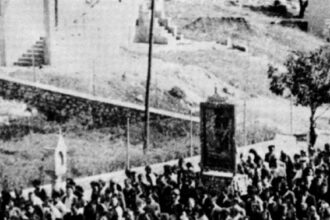
On the afternoon of September 26, the funeral procession began. Over two hundred priests, sixty Capuchin friars, dozens of bishops, and hundreds of municipal mayors in formal tricolor sashes escorted the casket through the streets of San Giovanni Rotondo. Aerial photographs captured a sea of humanity filling every road, balcony, and hillside.
According to municipal burial records, the casket was sealed in accordance with Italian sanitary laws and canonical norms. The inner coffin of polished chestnut was soldered inside a zinc container, which was then enclosed within an outer oak casket. At 10:30 PM, the casket was lowered into the newly constructed crypt beneath the sanctuary altar, sealed behind reinforced concrete and marble, where it would remain undisturbed for forty years.

Spiritual Reality & Discernment: Not an End, But a Beginning
As the final concrete slab was rolled into place over the crypt, the pilgrims did not disperse in despair. The overwhelming atmosphere in San Giovanni Rotondo was not gloom, but a profound, reverent peace. Those who had known him remembered his promise:
“Do not weep for me. I will be much more alive after my death than I ever was on earth. Pray, and I will be near you.”
The burial of Padre Pio was not the closing of a chapter, but the launch of a global phenomenon that would soon sweep across five continents, touching millions of lives and leading directly to the altars of the universal Church.

Institutional Bibliography & Primary Sources
The documentation and historical photographs of the funeral and public mourning of September 1968 are preserved in official records:
- Ruffin, C. Bernard. Padre Pio: The True Story. Our Sunday Visitor, 1991, Epilogue: “The Departure.”
- Prefettura di Foggia. *Rapporto dell’ordine pubblico per le esequie di Padre Pio da Pietrelcina (23–26 Settembre 1968).* State Archives of Foggia.
- Zavala, José María. Padre Pío: Los milagros desconocidos del santo de los estigmas. LibrosLibres, 2010.
- Comune di San Giovanni Rotondo. *Atti municipali delle esequie solenni e sepoltura del Padre Pio.* Municipal Archives.
Continue reading our 52-week archival investigation: explore the deep clinical and pathological mystery of how fifty years of open wounds left zero scar tissue in our next installment: Part 45: The Medical Enigma of the Vanishing Scars: A Pathology Paradox.