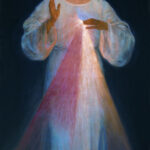
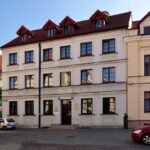
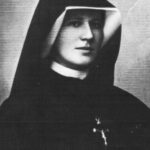

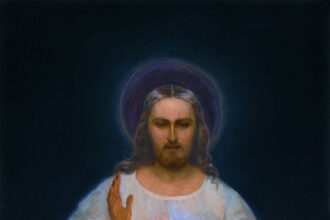
Between January and June 1934, an academic painter trained in Paris and Munich sat before an easel on Rasų Street in Vilnius, struggling to satisfy a nun who had never seen an art museum. When the painting was finally complete, she burst into tears before the tabernacle.
Key Findings & Archival Record
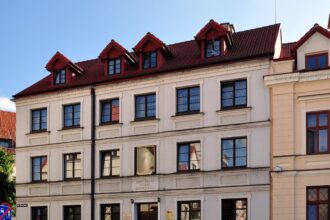
- Setting & Personnel: January to June 1934; studio of Eugeniusz Kazimirowski, 6 Rasų Street, Vilnius; accompanied by Father Michał Sopoćko.
- The Method: Father Sopoćko dressed in a priest’s alb to model the drapery and stance; Sister Faustina attended weekly to correct posture, gaze, and lighting.
- The Crisis: Upon completion, Faustina wept inconsolably in the Bernardine chapel, heartbroken that human paint could not capture the majesty of the living Christ.
- The Divine Consolation: Christ delivered the famous answer in entry 313: “Not in the beauty of the color, nor of the brush lies the greatness of this image, but in My grace.”
1. Scene Lede: The Priest in the Alb
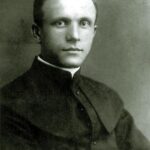
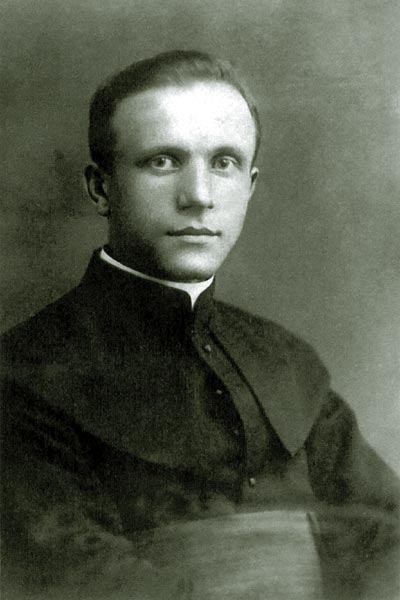
Every Saturday afternoon during the frozen winter of 1934, two unusual visitors walked up the stairs to 6 Rasų Street in Vilnius. One was Father Michał Sopoćko, professor of pastoral theology; the other was Sister Faustina Kowalska, cloaked in her heavy black woolen habit.
The painter they hired, Eugeniusz Kazimirowski, was a respected member of the Polish academic art establishment. Kazimirowski was accustomed to wealthy patrons and high-society portraits. Yet here, a university professor was donning an alb and standing frozen in the middle of the studio so the painter could capture the folds of linen, while an uneducated nun examined every stroke with uncompromising precision.
2. Archival Record: The Tears of the Mystic
Kazimirowski scraped away the paint and restarted multiple times. The angle of the head had to be tilted slightly forward; the gaze had to be cast downward, “like My gaze from the Cross.” (Diary, 326). The rays could not be sharp laser beams; they had to be diffuse, translucent founts emerging from an unseen depth.
In June 1934, the final varnish was applied. Kazimirowski stepped aside, expecting gratitude. Instead, Faustina broke down in tears. Leaving the studio, she ran to the nearby chapel of the Bernardine Sisters and poured out her heart to the Lord:
“Once, when I was visiting the artist who was painting the image, and saw that it was not as beautiful as Jesus is, I felt very sad about it, but I hid this deep in my heart… In the chapel I wept a great deal. ‘Who will paint You as beautiful as You are?’ Then I heard these words: Not in the beauty of the color, nor of the brush lies the greatness of this image, but in My grace.” (Diary, 313)
3. Spiritual Discernment: The Limits of Human Genius
Faustina’s grief at Kazimirowski’s easel contains a vital truth for every Christian creative, writer, and teacher: human expression can never fully contain divine majesty. Whether writing theology, composing music, or painting an icon, our work will always feel like broken stammering compared to the glory of God.
Christ’s answer reorients our focus: the power does not reside in aesthetic perfection. It resides in the grace channeled through our willingness to obey.

Institutional Bibliography & Primary Sources
- Kowalska, St. Maria Faustina. Diary: Divine Mercy in My Soul. Stockbridge, MA: Marian Press, 2005. (Entries 313, 326).
- Sopoćko, Blessed Michał. Memoirs of Sister Faustina. Białystok Archives, 1948.
- Kazimirowska, Jadwiga. Recollections of the Painter Eugeniusz Kazimirowski. Vilnius Historical Society, 1962.