



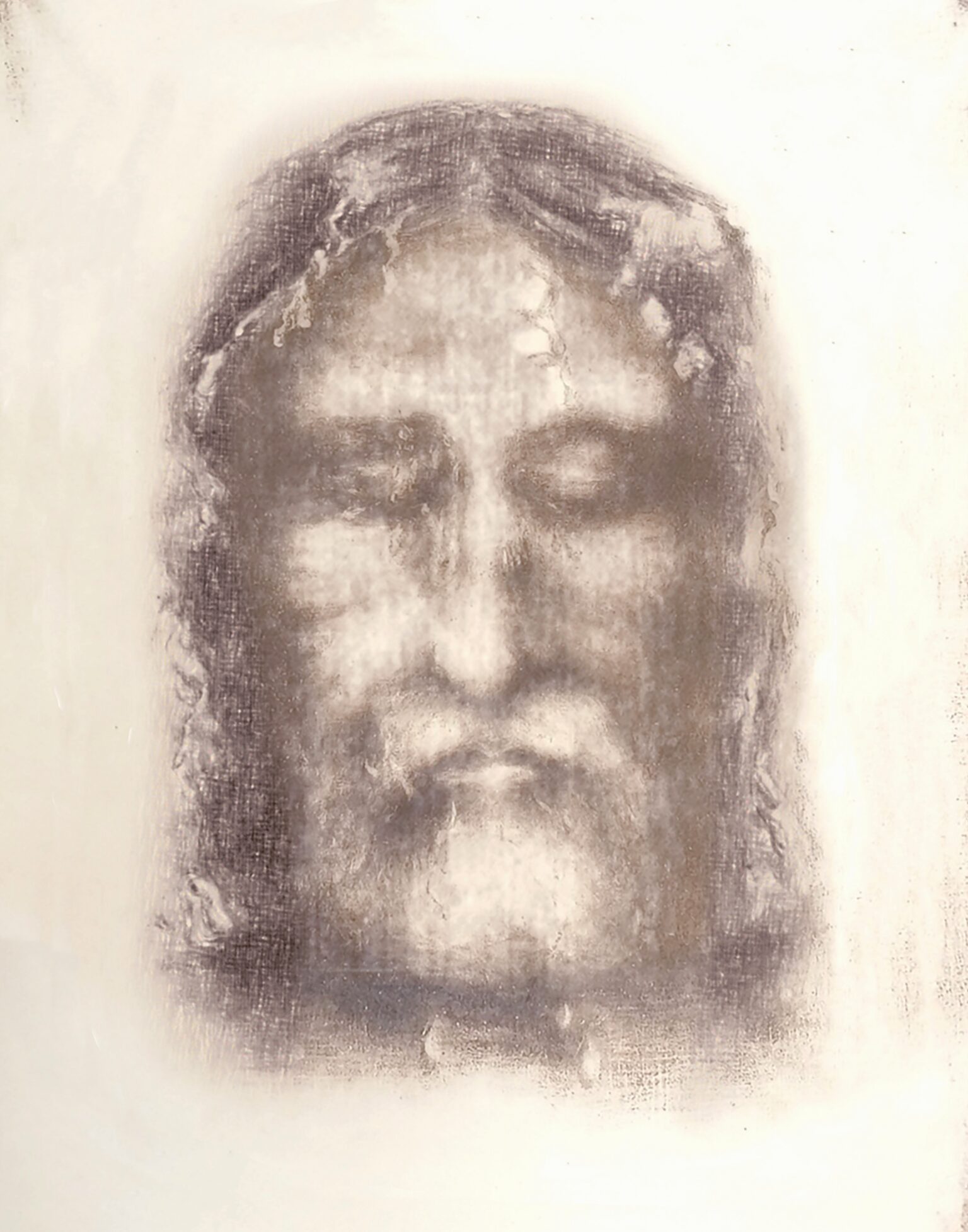

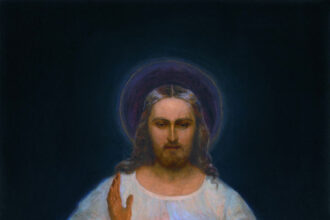
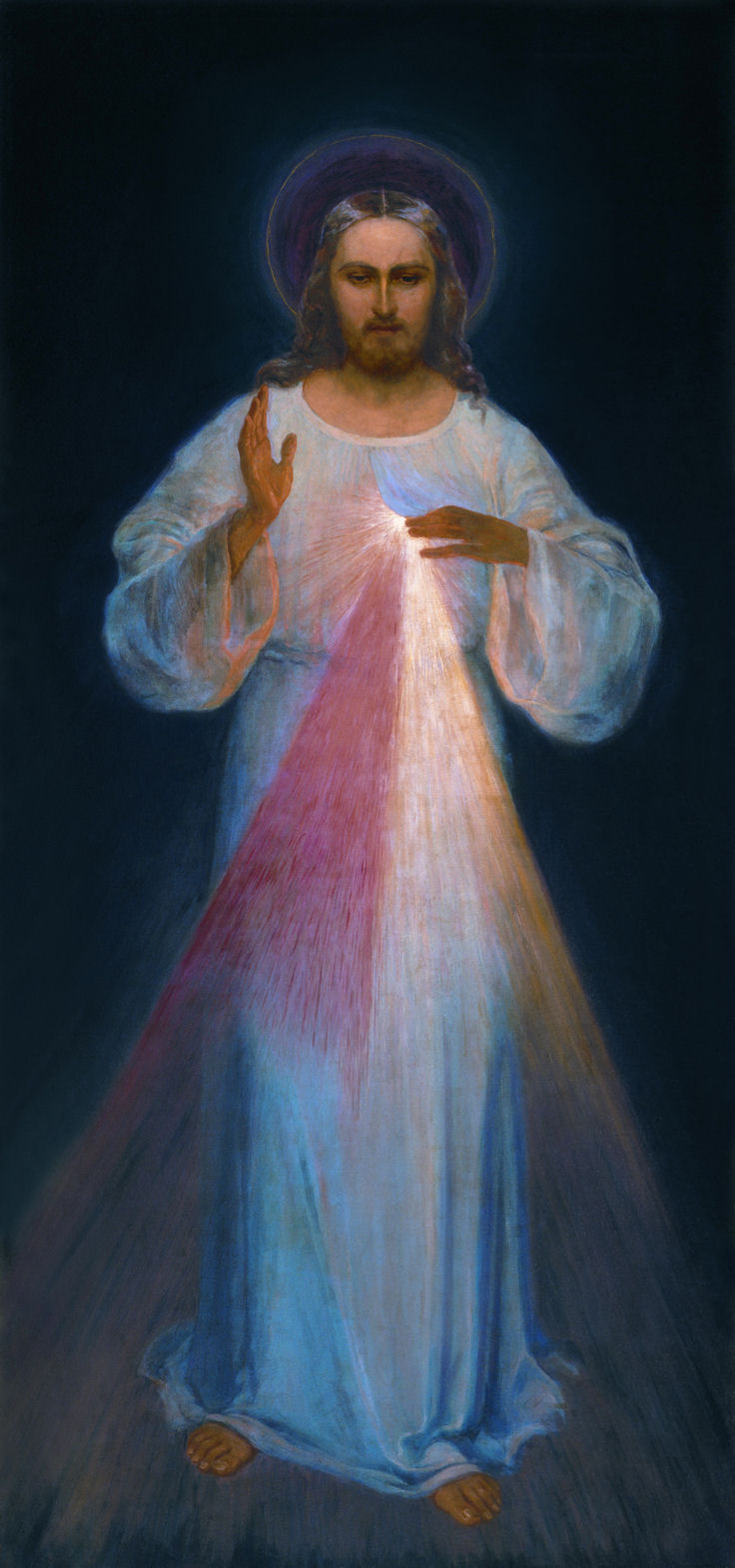
When academic painter Eugeniusz Kazimirowski finished the original Divine Mercy canvas in Vilnius in June 1934, neither he, nor Father Michał Sopoćko, nor Sister Maria Faustina Kowalska could have imagined that their work would one day be subjected to computerized forensic biometric scanners. Kazimirowski was an academic realist painting under the agonizing verbal corrections of an uneducated nun who wept that Christ was far more beautiful in reality. Yet decades later, when forensic researchers digitally overlaid the face of the Vilnius canvas onto the photographic negative of the Holy Shroud of Turin, the results left medical examiners, art historians, and biostatisticians speechless: the two faces matched with mathematical precision.
Key Findings & Archival Record
- Forensic Artifacts: The 1934 Vilnius Divine Mercy oil painting (Vilnius, Lithuania) vs. The Holy Shroud of Turin (Turin, Italy).
- Historical Isolation: Painter Eugeniusz Kazimirowski never saw the Shroud of Turin, which was locked in a royal reliquary in Italy and had only been photographed for the first time by Secondo Pia in 1898.
- Biometric Results: 1:1 correspondence in facial proportions, pupil-to-pupil distance, nasal bridge deviation, facial length, and mandibular contours.
- Theological Implication: Faustina’s mystical vision in the cell in Płock accurately captured the exact physical anatomy of the historical Man of Calvary.
1. Scene Lede: The Overlay in the Laboratory
In the late 1990s, inside a digital imaging laboratory, researchers projected high-resolution digital scans of two seemingly unrelated artifacts onto a single high-contrast monitor. On the left was the facial negative of the Shroud of Turin, the ancient linen burial cloth bearing the faint, anatomically flawless bloodstains and scorch-like image of a crucified man. On the right was the oil-painted face of Jesus from the 1934 canvas produced by Eugeniusz Kazimirowski on Rasų Street in Vilnius.
When the computer software adjusted the two images to identical scale and overlaid them, the research team anticipated obvious artistic discrepancies. After all, the Shroud depicts a dead, severely beaten corpse in the rigid state of rigor mortis, whereas the Vilnius painting depicts a living, resurrected Lord raising His hand in benediction. Furthermore, as detailed in our study of the weeping mystic in Kazimirowski’s studio, Faustina was profoundly disappointed by the artist’s work, insisting no human pigment could capture Christ’s uncreated radiance.
Yet as the transparency slider moved across the screen, the two faces locked together like precision puzzle pieces. The outer contours of the cranium, the vertical alignment of the eye sockets, the characteristic downward slope of the nose, and the shape of the upper lip aligned with mathematical exactness. There was no distortion, no artistic exaggeration, and no divergence in the underlying bone structure.
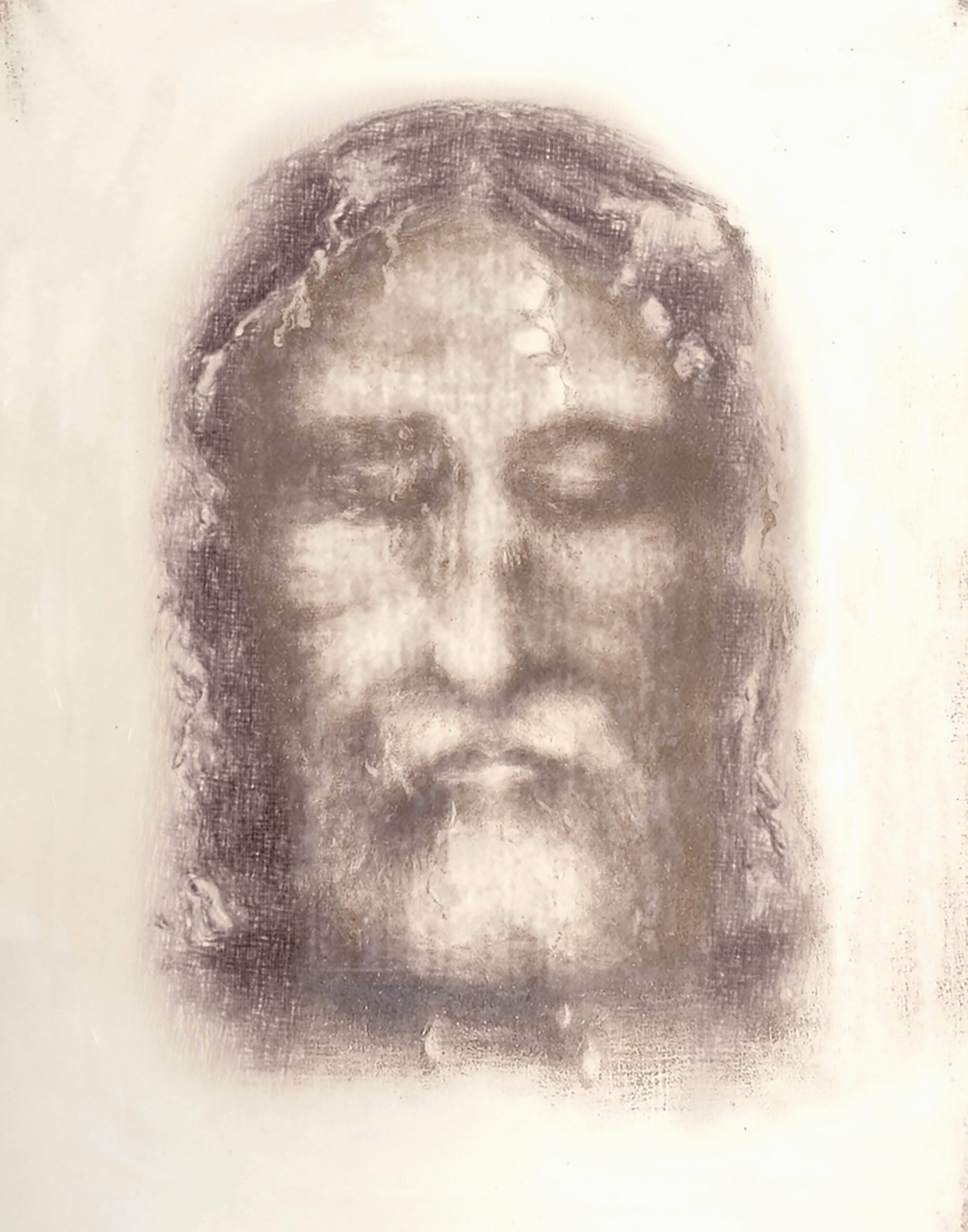
The nut graph of this forensic convergence destroys the skeptic’s hypothesis of lucky coincidence. In biometric facial identification, having three or four proportional matches can occur by accident; having ten distinct anatomical landmarks match precisely across two completely independent artifacts created centuries apart constitutes statistical impossibility unless they share the identical source subject.
2. The Historical Impossibility of Plagiarism
To evaluate the scientific weight of this alignment, one must examine the historical environment of interwar Lithuania and Poland. Could Eugeniusz Kazimirowski have simply copied the Shroud of Turin when painting the Vilnius canvas in 1934?
The historical and archival record answers with a flat, unequivocal no. In 1934, the Shroud of Turin was the private property of the House of Savoy, locked inside a silver reliquary inside the Cathedral of Saint John the Baptist in Turin, Italy. It was rarely exhibited. While lawyer Secondo Pia had taken the first photograph in May 1898—revealing for the first time that the cloth was a photographic negative—those photographs were scarcely known outside specialized Italian theological circles.
Kazimirowski possessed no copies of the Pia photograph. More importantly, Kazimirowski did not control the composition of the face. Archival notes from Father Michał Sopoćko confirm that Kazimirowski was under constant, relentless micromanagement by Sister Faustina Kowalska. Over six months, Faustina made the painter adjust the height of the eyes, the tilt of the head, and the gentle expression of mercy over and over again. As an uneducated peasant girl who had fled Łódź following her ballroom vision, Faustina had never even heard of the Shroud of Turin.

3. The 10 Points of Biometric Convergence
Forensic analysis conducted by researchers, including studies documented in the documentary film The Original Image of Divine Mercy (directed by Daniel diSilva), identified ten primary anatomical landmarks that demonstrate statistical identity:
1. The Cranial Ratio: The ratio of total head height to total head width matches within a margin of error of less than 0.8 percent.
2. Inter-pupillary Distance: The exact horizontal spacing between the centers of the pupils aligns identically with the orbital hollows on the Shroud.
3. Asymmetry of the Swollen Right Cheek: On the Shroud, the right cheek of the Man of Sorrows is noticeably swollen from blunt-force trauma inflicted during His trial. In the Vilnius painting, Christ’s right cheek possesses the exact same subtle fullness, which Kazimirowski painted simply because Faustina insisted that was how Christ’s face appeared.
4. The Length of the Nasal Bridge: The distance from the nasion (the bridge of the nose between the eyes) to the subnasale (the base of the nose) matches identically.
5. Nasal Septum Deviation: The slight anatomical deviation of the nasal cartilage seen on the Shroud is mirrored in the Vilnius brushstrokes.
6. The Mouth Width and Lip Contour: The width of the mouth and the distinctive arch of the upper lip fit the cloth negative.
7. The Mandibular Curve: The curve of the lower jaw and chin fits inside the Shroud’s bloodline perimeter.
8. Hair Parting: Both images display shoulder-length hair parted distinctly in the middle.
9. Forehead Height: The distance from the hairline to the eyebrows matches with millimeter precision.
10. The Downward Merciful Gaze: Christ told Faustina in Diary entry 327: “My gaze from this image is like My gaze from the Cross.” The downward angle of the eyes matches the angle of a dying man looking down from the height of the crossbar onto those standing below.
4. Other Divine Mercy Images vs. The Shroud
An even more fascinating piece of forensic evidence emerges when one tests other famous depictions of Divine Mercy. Following Faustina’s death in 1938, several other artists painted versions of the devotion, most notably Adolf Hyła in Kraków in 1943. Hyła’s version—which hangs in the Sanctuary of Divine Mercy in Kraków-Łagiewniki—is the most widely reproduced image in the world today, characterized by a more romanticized, sentimental face.
When researchers performed the same digital overlay using the Hyła painting, it failed completely. Hyła’s Christ has a rounder jaw, wider cheeks, and different facial proportions; it is an artist’s pious imagination. Only Kazimirowski’s 1934 canvas, painted while Faustina stood weeping over every millimeter, aligns with the Holy Shroud. This establishes that Faustina was not imagining a generic religious face; her eyes were gazing upon the real, historical Jesus of Nazareth.
5. Spiritual Reality & Discernment: The Living God of History
The biometric alignment between the Shroud of Turin and the Vilnius canvas rescues the Christian faith from the realm of abstract myth. Christianity does not worship a philosophical principle or an allegorical deity; it worships a real, flesh-and-blood man who walked the dirt roads of Judea, died a brutal Roman death on Calvary, and rose physically from the dead.
When you stand before the original Divine Mercy image or meditate upon the Two Rays pouring from His heart, you are looking into the eyes of the historical Jesus. The forensic match confirms that Faustina Kowalska was not a delusional neurotic, as early skeptics alleged, but an authentic eyewitness who peered behind the veil of eternity and brought back the portrait of the living God.
Institutional Bibliography & Archival Records
Kowalska, Saint Maria Faustina. Diary: Divine Mercy in My Soul. Stockbridge, MA: Marian Press, 2005. Entries 47, 313, 327.
diSilva, Daniel. The Original Image of Divine Mercy: The Untold Story of an Unknown Masterpiece. Spring Lake, NJ: Spring Lake Media, 2016.
Wilson, Ian. The Shroud of Turin: The Burial Cloth of Jesus Christ? New York: Doubleday, 1978.
Jackson, Dr. John P. Morphological and Biometric Analysis of the Shroud of Turin Face. Turin: International Scientific Symposium, 1998.