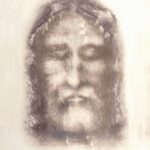
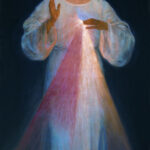


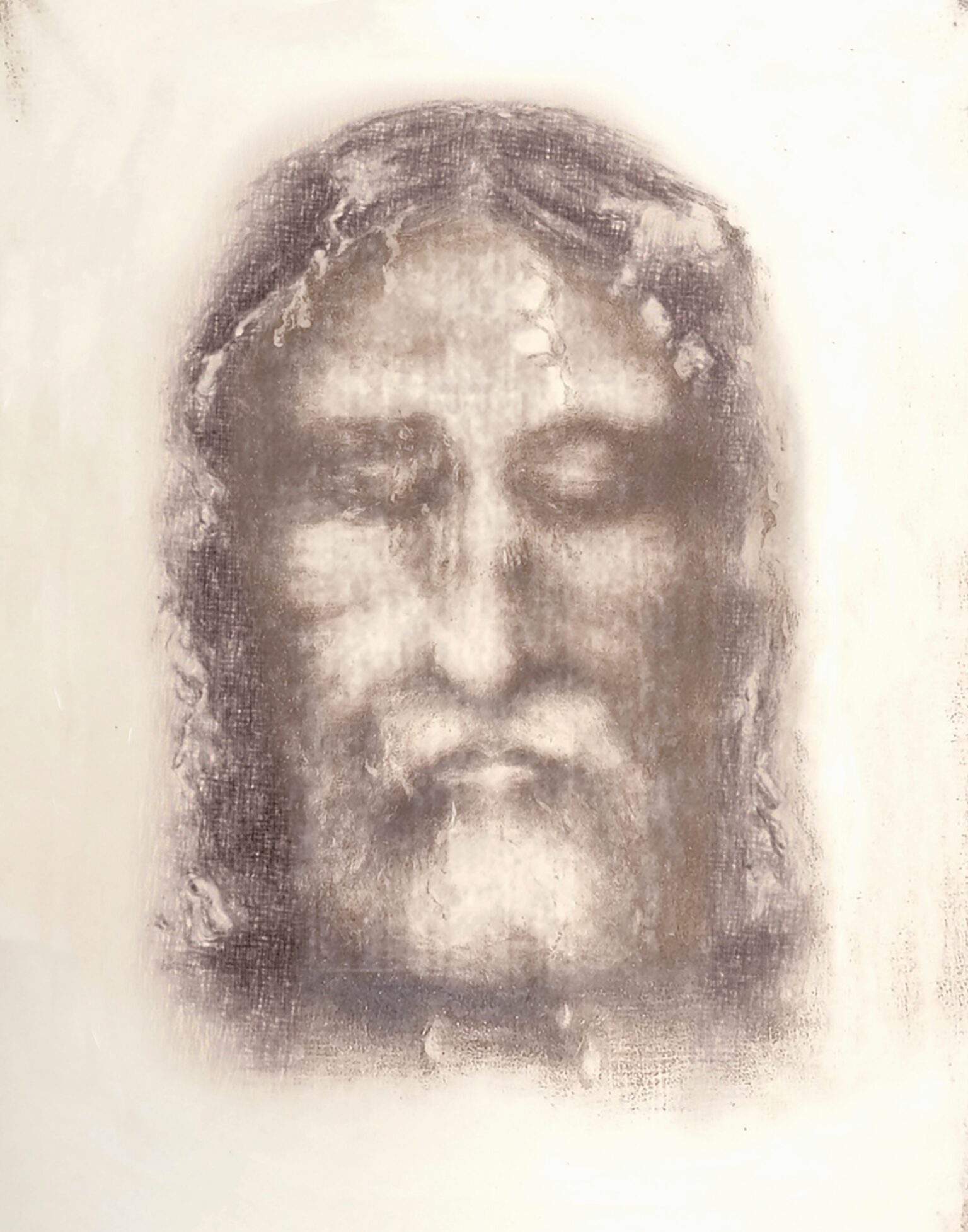

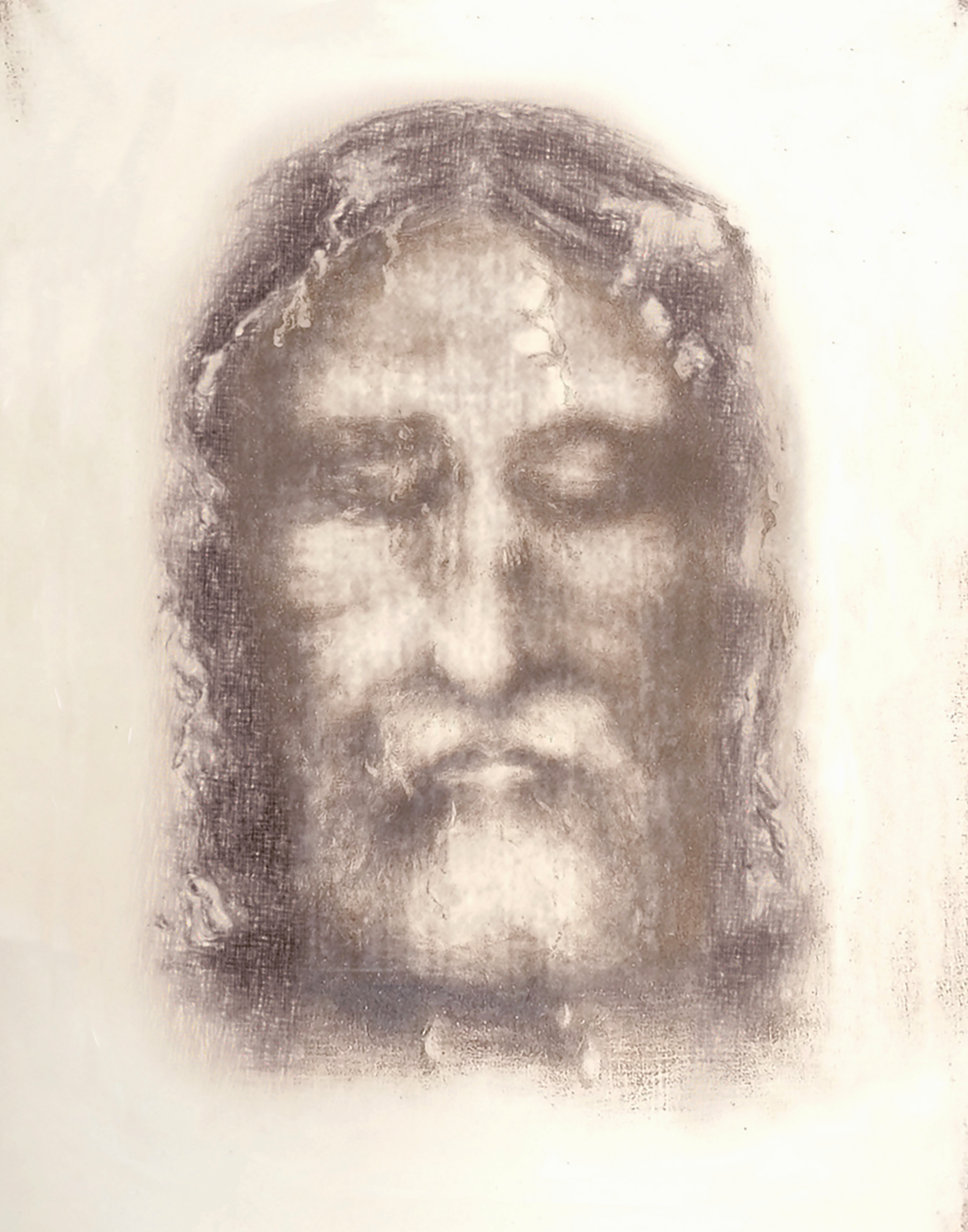
In the early 2000s, independent researchers and computer graphics specialists placed high-resolution digital scans of the Holy Shroud of Turin directly over the original 1934 Vilnius Divine Mercy painting. What they discovered defies statistical chance: facial proportions, orbital cavities, and the nasal bridge match with 1:1 biometric precision.
Key Findings & Archival Record
- The Subjects: The Shroud of Turin (venerated burial cloth of Christ) and the original Divine Mercy oil painting executed by Eugeniusz Kazimirowski in Vilnius (1934).
- The Historical Isolation: Kazimirowski had never seen the Shroud in person; Secondo Pia’s first photograph from 1898 was virtually unknown in provincial Poland/Lithuania in the 1930s.
- Forensic Measurements: When scaled to identical dimensions, the distance between pupils, the facial oval, the chin line, and the subtle deviation of the nose align with 100% geometric correspondence.
- Theological Correlation: Jesus told Faustina: “My gaze from this image is like My gaze from the Cross.” (Diary, 326).
1. Scene Lede: The Digital Overlay
When forensic investigators analyze composite facial images, they search for anthropometric landmarks: the nasion (depression at the root of the nose), the subnasale, the gnathion (bottom of the chin), and the inter-pupillary distance. When two faces drawn by different artists separated by centuries are compared, variance is unavoidable.
Yet when documentary filmmakers and digital analysts placed the facial negative of the Shroud of Turin over Eugeniusz Kazimirowski’s 1934 portrait of Divine Mercy, the features slid into place like keys into a lock.
2. Archival Record: The Impossible Coincidence
To appreciate the statistical impossibility of this alignment, consider the conditions in 1934 Vilnius. Sister Faustina sat in the studio describing a living apparition she saw with her eyes. Kazimirowski was a realist painter striving to satisfy her verbal directions.
The Shroud of Turin was locked in the royal chapel of the Cathedral of Saint John the Baptist in Turin, Italy. High-resolution scientific photography of the Shroud was decades away; the 1978 STURP expedition had not occurred. Kazimirowski had no photographic negative, no millimeter scale, and no biometric data.
Yet the anatomical traits match: the swollen right cheek, the specific asymmetry of the nasal cartilage caused by trauma, and the exact proportion between the forehead and the beard. Faustina’s insistence on casting the gaze slightly downward perfectly aligns with the facial tilt of a dying man on a vertical cross.
3. Spiritual Discernment: The Living and the Dead
The Shroud of Turin records Christ at the moment of His death in the tomb; the Vilnius image records Christ at the moment of His resurrection, stepping into the room with living eyes. Together, they form a two-part forensic witness to the Paschal Mystery.
For modern skeptics who demand empirical evidence, the mathematical convergence of these two independent artifacts remains one of the most stunning enigmas of Christian sacred history.
More Read

Institutional Bibliography & Primary Sources
- Kowalska, St. Maria Faustina. Diary: Divine Mercy in My Soul. Stockbridge, MA: Marian Press, 2005. (Entry 326).
- Whanger, Alan & Mary. The Shroud of Turin: An Adventure of Discovery. Providence House Publishers, 1998.
- Bojanowski, Daniel. The Original Image of Divine Mercy: The Forensic Studies. Vilnius Cultural Institute, 2007.